
Building a smarter, low-carbon future at Coleg Cambria
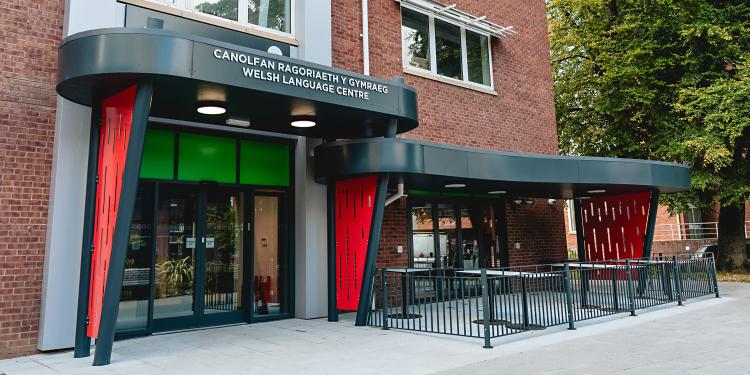
Targeted investment supports solar and smart energy upgrades at Coleg Cambria’s Yale site in Wrexham
Coleg Cambria is taking a significant step forward in its journey towards net zero, using new decarbonisation funding to transform one of its most community-facing buildings into a cleaner and more efficient space.
At the college’s Yale site in Wrexham, the Elwy Building is set to become a showcase for low-carbon learning.
The building houses a variety of facilities, including CAMU, the College's Centre of Excellence for Welsh language development. Additionally, it features community classrooms, a Welsh language coffee shop to enable learners to practice Welsh skills, a hairdressing salon and a modern agile working hub to support teaching and learning teams.
It is a space used daily by learners, colleagues and the wider community, making it an ideal place to demonstrate what decarbonisation can look like in practice.
Through the Digarbon 2 programme, Coleg Cambria will fully decarbonise the building’s heat by removing its existing gas boilers and replacing them with air source heat pumps for space heating and hot water. Roof-mounted solar photovoltaic (PV) panels will also be installed, allowing the building to generate clean electricity on site and reduce its reliance on the grid.
The project is being supported by Ynni Cymru grant funding, which will cover 75 per cent of the total costs, with the remaining 25 per cent match funding sought through the Salix Digarbon loan scheme for the low-carbon heat element. Digarbon is funded by the Welsh Government and delivered by our teams at Salix.
For the college, the funding provides the momentum needed to move faster and go further.
The college is committed to improving its environmental performance and fundamentally changing the way we operate to become a sustainable, low-carbon organisation.
This funding will allow the college to accelerate its decarbonisation programme and install roof-mounted solar PV panels to generate clean energy. We aim to embed sustainability as a core principle across all aspects of college operations, ensuring that learners and colleagues can contribute positively to a greener economy.
Rather than delivering upgrades in isolation, Coleg Cambria has taken a joined-up approach to how energy is used across the building. Alongside low-carbon heating and renewable energy, the Elwy Building will be fitted with smart technology designed to help the building respond to how it is used day to day.
This includes a central building management system that allows the estates team to monitor and control heating and energy use from one place, as well as sensors that detect when rooms are occupied so energy is not wasted heating or lighting empty spaces. A contactless electric vehicle charging point will also be installed, making it easier for staff and visitors to charge electric vehicles on site.
Together, the teams say these upgrades will help the building use energy more efficiently, reduce unnecessary waste and give the college greater insight into how the building performs, supporting continuous improvement over time.
The technologies will also help create an environment that allows learners to engage with real-world low-carbon systems as part of their education.
For us at Salix, the project reflects the wider ambition of Digarbon 2 to support practical, people-focused decarbonisation across Wales’s public sector estate.
Projects like this show how decarbonisation can be built into the everyday spaces people use and rely on. By combining low-carbon heat, renewable generation and smart controls, Coleg Cambria is creating a building that works better for its users while cutting carbon and energy costs.
As work progresses, the Elwy Building will stand as an example of how further education buildings can support both climate goals and community use. By investing in cleaner heat, smarter systems and on-site renewable energy, Coleg Cambria is laying the foundations for a more resilient, low-carbon future, one that supports learners today while helping to build the greener economy of tomorrow.
Coleg Cambria’s project is one of several successful applications under Digarbon Round 2, a £15.3 million loan fund delivered by Salix on behalf of Welsh Government. The programme supports further and higher education institutions across Wales to reduce carbon emissions through low-carbon heat, energy efficiency, renewables and electric vehicle infrastructure.
Alongside Coleg Cambria, successful applicants include Cardiff Metropolitan University, Swansea University and Bangor University. Together, these projects represent a significant step forward in reducing emissions across Wales’s education estate while modernising facilities used by thousands of students and staff every day.


