
Brasenose College enhances student life with sustainable heritage upgrades
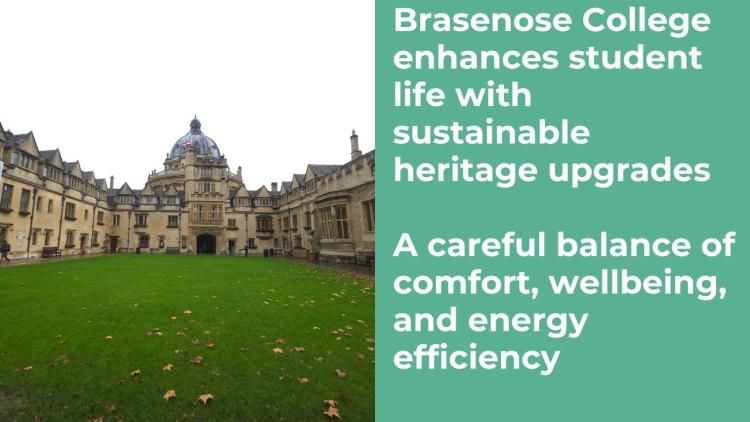
A careful balance of comfort, wellbeing, and energy efficiency shows how historic Oxford colleges can adapt for a greener future
Oxford’s historic colleges are accelerating their journey to net zero with support from the Public Sector Decarbonisation Scheme, demonstrating how centuries-old buildings can be sensitively transformed for a low-carbon future.
We have been working closely with colleges across the university as they pursue ambitious goals to achieve net zero carbon emissions and a net gain in biodiversity by 2035.
As part of this work, our teams recently visited Brasenose College and Magdalen College - two landmark institutions that have undertaken major decarbonisation projects with scheme funding.
Our visit offered a unique opportunity to go behind the scenes, hear directly from college leaders, and see how each site is balancing the demands of preserving heritage with the need for modern, energy-efficient infrastructure.
Oxford’s wider vision for a low-carbon estate
The University of Oxford has committed to a comprehensive decarbonisation strategy focused on retrofitting existing buildings, integrating renewable energy systems, and adopting Passivhaus principles in new construction.
Initiatives including Oxford Net Zero, the ZERO Institute and the Oxford Offsetting Principles continue to position the university as a global leader in climate research and carbon reduction.
Within this context, the colleges, custodians of some of Britain’s most treasured architectural heritage, are working to ensure their historic estates remain resilient, functional, and sustainable long into the future.
Brasenose College: Deep retrofit at the heart of Oxford
Brasenose College, a Phase 3b Public Sector Decarbonisation Scheme recipient, has undertaken a major retrofit of a listed building in central Oxford, transforming it into modern, efficient student accommodation.
Supported by £349,553 in grant funding from the scheme, delivered by our teams on behalf of the Department for Energy ad Net Zero, the project includes the installation of ground source heat pumps, secondary glazing, loft, wall and floor insulation, and mechanical ventilation with heat recovery (MVHR).
The overall project cost is significantly higher, reflecting the complexities of delivering low-carbon upgrades within a constrained and archaeologically sensitive location.
During our visit, bursar Philip Parker emphasised the college’s commitment to student wellbeing.
Our students are key to everything we do at Brasenose. We want students to choose our college and, once here, we aim to create the best possible environment in which they can live and learn.
Domestic bursar Kristian Sadler added: “We’re delighted with this project and with everything we have achieved through the Public Sector Decarbonisation Scheme and beyond.”
New heating systems and improved energy controls are already making a meaningful difference to comfort and day-to-day use of the building.
The retrofit sits above a Norman-period basement where Iron Age artefacts were discovered during the initial phases of work, an illustration of the unique challenges and extraordinary opportunities that come with upgrading historic buildings.
Working in a heritage setting comes with its challenges, from access for drilling equipment to preserving archaeological layers.
It’s a remarkable chance to show how sustainability and heritage can coexist beautifully
Brasenose continues to enhance sustainability across its estate, including energy-efficient lighting, heating upgrades and responsible procurement - contributing to Oxford’s broader 2035 net-zero target.
Collaboration for a sustainable future
At Salix we continue to work across the public-sector delivering the last phase of the Public Sector Decarbonisation Scheme up until 2028, funding energy-efficiency improvements and low-carbon heat upgrades across public buildings.
Our client support officer Claudia Head said: “At Brasenose College, heritage and innovation combine seamlessly. Their commitment to sustainability is a powerful example of what happens when history and modern science come together.”
Colleague Anna Kuratnikova added: “It’s fascinating to see heritage being safeguarded in such a forward-thinking way.
“By combining modern energy-efficiency measures with careful preservation, we’re not just protecting the past, we’re ensuring that these historic treasures continue to inspire and serve future generations, proving that sustainability and history can thrive together.”


