
11,900 homes upgraded through government energy efficiency scheme
How the Home Upgrade Grant Phase 2 scheme is benefitting thousands this winter
As the colder winter months continue, thousands of people and families across the country are benefiting from warmer homes and lower energy bills.
These benefits are a result of energy-efficient retrofit upgrades funded through the government’s Home Upgrade Grant Phase 2 (HUG2).
The scheme, which formally closed last year, provided energy efficiency upgrades and low-carbon heating.
It was delivered through local authority funding to households in England that were low-income, off the gas grid, or had an energy performance certificate (EPC) rating between D and G.
Energy Performance Certificates assess a building's energy efficiency and help residents understand energy use, identify areas for improvement, and potentially save money on energy bills.
Latest statistics, as published on the gov.uk website, confirms that a total of 11,900 homes were upgraded with 22,000 measures.
The installation of these measures, as listed in official statistics, is projected to save these households a combined total of more than £2.95 million in annual energy bills.
It's also projected that these measures will save 9.3 tonnes of carbon emissions annually*, equivalent to driving 86,111 miles – enough to get you from London to Glasgow 250 times**.
Our director for housing Paul Hill said: “For the people and families living in these homes, these upgrades should be providing better confidence that they can stay warm this winter with less financial stress.”
For the people and families living in these homes, these upgrades should be providing better confidence that they can stay warm this winter with less financial stress.
Our teams at Salix assured the funding provided for the HUG2 scheme, which was delivered on behalf of the Department for Energy Security and Net Zero.
During the final months of delivery, we visited multiple residents to hear about the difference that upgrades were making for their homes and lives – hear more about what they had to say below.
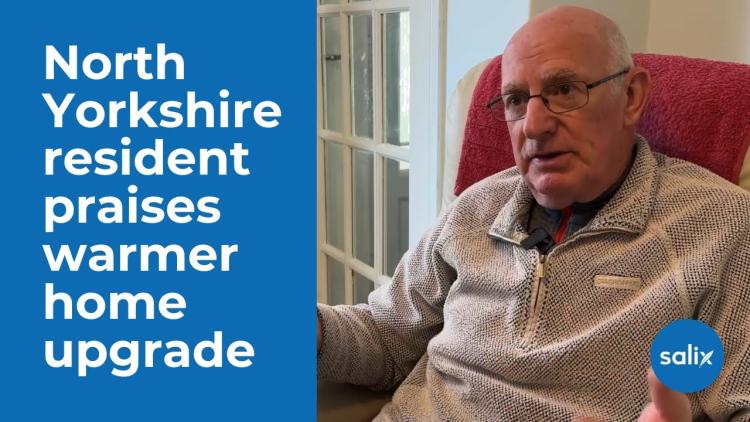
North Yorkshire resident praises warmer home upgrade
David Fielding has lived in the quiet North Yorkshire village of Kirkby Fleetham for more than two decades, but until recently found the winter months very uncomfortable and challenging. However, after 23 years heating his home with oil during the colder months, David’s home is now kept warm with a zero direct emission air source heat pump.
He’s also had solar installed on his roof to generate clean, green energy for his home and his loft insulation was topped up.
Norfolk residents praise energy efficiency upgrades to their homes
The district of Great Yarmouth is home to a diverse population of around 100,000 residents and has one of the highest rates of deprivation anywhere in the country.
Residents Ann and Tony Fallowes have lived in their home in Hemsby for 47 years, having raised their children – and multiple pets – at the property over that time.
Previously heated with oil, the retired couple now warm their home with a low-emission air source heat pump. It is an upgrade they say has created a more comfortable warmth which is more evenly distributed across the house.
Alongside their air source heat pump, Ann and Tony’s home received solar panels and top-up loft insulation. On a sunny day, the couple’s smart meter showed £0 for electricity costs, thanks to the renewable energy generated by the panels.
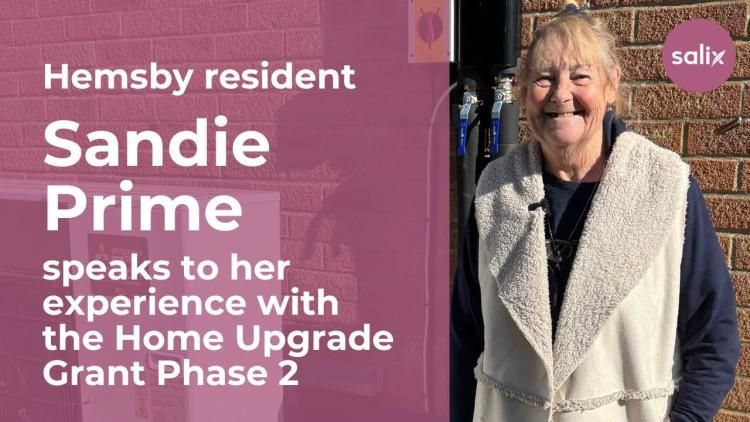
For local resident Sandie Prime, also of Hemsby, upgrades have been transformational.
Watch our short video below to hear Sandie speak about her experience with the scheme.
Bristol residents praise warmer homes scheme for transforming their houses
We were in Bristol to speak with Gillian and Harriet, who both praised the work as “transformational, completely changing the comfort of their homes."
The visit was hosted Bristol City Leap, set up as a 20-year partnership between the local council and Ameresco to accelerate decarbonisation and green energy projects across the city.
Gillian lives in a 300-year-old cottage in Lamb Hill. She’s lived in the property for 44 years and it’s where she raised her three children and where her three grandchildren now come to visit.
Prior to upgrades, she had to lug bags of coal up and down a steep slope to her property to power the boiler that provided her with heating.
Harriet has lived in her post-war build, end-terrace property in Selby for half a century.
Her home was previously heated by three storage heaters, two of which were broken or faulty.
Thanks to upgrades funded through the scheme, both women heat their homes with air source heat pumps.
Additionally, they’ve had solar panels fitted to their roofs, loft insulation and additional ventilation measures installed.
Read more about their experience through the news story on our website.
Paul added: “The stories we’ve heard from these residents represent just a small portion of the real-world difference the scheme has had for the wider community, and we’re incredibly proud of what it has achieved.
“Credit must be given where it’s due – to the dedicated teams working at all 45 local authorities who delivered through the scheme.
“It is these people whose passion, care and dedication have driven this work to succeed and who, we know, want to see the positive difference it will make for people in their community.”
Many grant recipients who received funding through the scheme are continuing to deliver energy-efficient retrofit upgrades through future schemes such as Warm Homes: Local Grant.
Paul added: “We hope by next winter that thousands more will be experiencing the same benefits we’re seeing and hearing about today.”
We hope by next winter that thousands more will be experiencing the same benefits we’re seeing and hearing about today.
*Estimated carbon savings are based on the carbon intensity factors taken from the Greenhouse Gas Inventory (GHGI) and Green Book.
**Carbon calculations have been generated through a tool created by our in-house carbon and technical experts. The intention is to provide carbon savings estimates to aid with a common understanding of emission data and statistics. These estimates are approximate it is not recommended to use this tool for formal carbon emissions analysis. The tool uses UK government conversion factors alongside emissions estimates sourced from various studies, but it is possible a margin of error may exist. For more information about the formulas and methodology used in this tool, please contact us at [email protected]. E&OE.


