Milton Keynes University Hospital advances major low-carbon heat network project
Backed by Public Sector Decarbonisation Scheme funding, the scheme is cutting emissions, upgrading infrastructure and supporting the NHS’s journey to net zero
A major decarbonisation project at Milton Keynes University Hospital NHS Foundation Trust is gathering momentum, thanks to £12.9 million Public Sector Decarbonisation Scheme funding.
Funded through Phase 3c of the Public Sector Decarbonisation Scheme, the project is expected to deliver annual carbon savings of nearly 2,900 tonnes while transforming how heat is generated and distributed across the hospital estate.
During a recent visit by our Salix team, we were able to explore how partners and hospital leaders are reviewing progress, with discussions focusing on delivery challenges, early successes and the long-term vision for a low-carbon NHS estate.
This project gives us a great vision of the future, creating a more energy efficient site and making the buildings more comfortable for patients, teams and visitors.
Public funding enabling transformation
Salix programme co-ordinator Justin Morris emphasised the broader impact of the scheme, highlighting how public sector funding has enabled a step-change in infrastructure that would otherwise be out of reach.
He said: “This project gives us a great vision of the future, creating a more energy efficient site and making the buildings more comfortable for patients, teams and visitors.
“What’s particularly encouraging is that during our visit we were able to hear how there are already benefits in completed areas. In wards like Antenatal and the Antenatal Day Assessment Clinic, feedback from midwives, patients and nurses has been really positive. That’s a strong sign that the hospital is heading in the right direction.”
Justin’s comments reflect how the scheme is not just about long-term carbon reduction, but also immediate improvements to patient experience and staff working conditions which is a key priority for NHS estates.
Hospital leaders also stressed that without the Public Sector Decarbonisation Scheme, the scale of the project would not have been feasible. They also emphasised the critical role of Salix in supporting the project.

Salix programme co-ordinator Justin Morris, is pictured centre, with colleague and assistant director Davide Natuzzi, and the Milton Keynes team behind the work
Photo credit: Salix Finance
Building a low-carbon heat network
At the centre of the programme is the hospital’s connection to the Milton Keynes District Heat Network, led by 1Energy with support from Fermatech and Fairheat.
Hospital director of estates and facilities Tony Marsh highlighted the strategic importance of the partnership.
He said: “This partnership will allow us to cut carbon emissions significantly while ensuring our heating infrastructure is resilient and future ready.
“We’re not just upgrading systems, we’re fundamentally changing how the hospital is powered, moving away from fossil fuels and towards a sustainable model that will support both our clinical needs and our environmental responsibilities for decades to come.”
The network will use heat pumps, thermal storage, and recovered waste heat from data centres to supply low-carbon heating across the city. Once fully operational, it is expected to significantly reduce emissions while supporting wider regional net zero ambitions.
Justin added: “What makes this project particularly powerful is its ability to turn wasted heat into something of real community value, providing efficient, low-carbon energy to critical infrastructure like hospitals. It’s about creating a cleaner, healthier and more sustainable future at scale.”
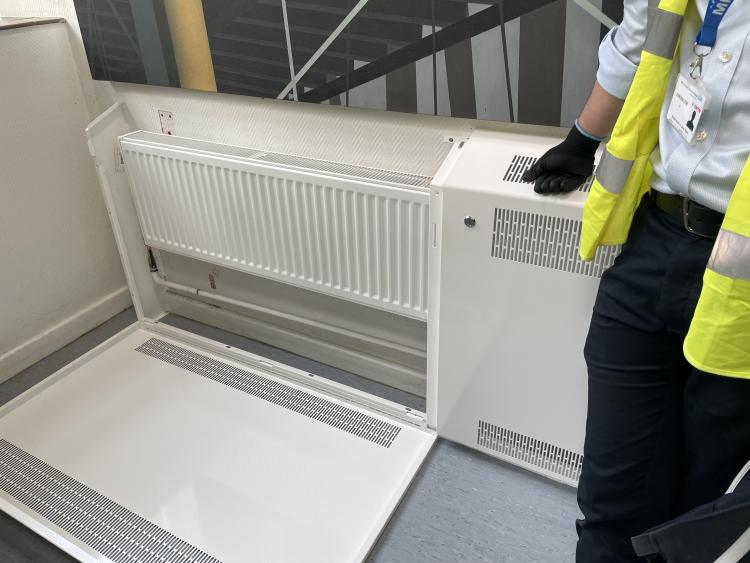
A radiator and low temperature surface cover at Milton Keynes University Hospital NHS Foundation Trust
Photo credit: Salix Finance
Delivering change in a live hospital
Alongside the network connection, the project includes the installation of around 1,600 upgraded radiators, designed to improve efficiency and integrate with the new heating system.
Delivering this work in a live hospital environment has required close collaboration with clinical teams to minimise disruption. A pilot ward installation helped refine the process, allowing teams to develop a repeatable model for rollout across dozens of departments.
The project team worked closely with nurses and ward leaders to manage installations safely and sensitively, from scheduling works around patient care to ensuring privacy and hygiene standards were maintained throughout.
Looking ahead
The hospital is expected to fully connect to the heat network by 2028, with interim systems in place to maintain reliable heating. Further upgrades, including ventilation improvements and infrastructure changes, will continue as part of a broader net zero programme.
Overall, the project will contribute to the Trust’s net zero ambitions.
Hospital estates project officer - decarbonisation Aidan Smith said: “We are proud of what has been achieved so far, but this is just one step in a much bigger journey.
“Our focus remains on creating a greener, more sustainable healthcare environment while continuing to deliver the highest standards of care for our patients.”
How the Milton Keynes heat network works
- A £95 million city-wide scheme will provide low-carbon heating to buildings across Milton Keynes
- Milton Keynes University Hospital NHS Foundation Trust will be the first site to connect
- Developed by 1Energy, the network captures waste heat from data centres and combines it with heat generated by energy centres
- The main energy centre, located near Linford Wood, will use large air source heat pumps to extract heat from the air
- Heat is distributed through around 20km of underground insulated pipes to connected buildings
- The system is expected to generate around 100 gigawatt hours of heat annually which is enough for around 20,000 homes
- By 2027, it aims to supply 74 large buildings, with future plans to expand to homes
- The project is backed by £17.6 million from the Green Heat Network Fund and more than £78 million in private investment
- It is expected to cut around 15,000 tonnes of carbon emissions each year
- Connected buildings could see heating emissions reduced by up to 75% compared to traditional gas boilers
The Salix visit highlighted how coordinated investment, strong partnerships, and government-backed funding are enabling the NHS to take meaningful steps toward decarbonisation - with Milton Keynes emerging as a leading example of what can be achieved.
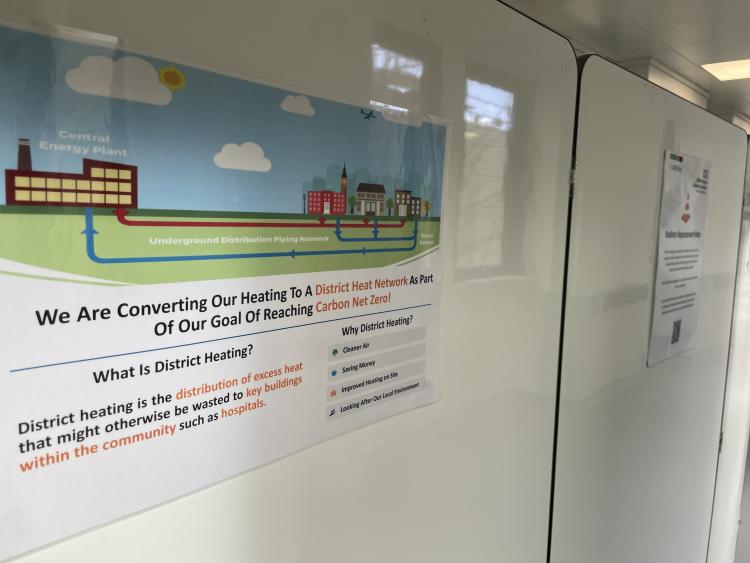
Photo credit: Salix Finance
Thank you to the team at Milton Keynes University Hospital NHS Foundation Trust for hosting the visit and explaining your vision. We’re proud to work with you on your net zero journey.