
North Herts Council advances net zero ambitions through major leisure centre decarbonisation programme
Keen leisure centre users in North Hertfordshire are enjoying better facilities, thanks to £9.2 million worth of energy efficiency upgrades.
At Salix, we’ve been working with North Hertfordshire Council to deliver major upgrades through the Public Sector Decarbonisation Scheme.
The council secured £7.7 million in funding through Phase 3 and Phase 3c of the Public Sector Decarbonisation Scheme to transform the energy performance of three of its most prominent leisure facilities.
With a total project value of £9.2m and a completion date of 30 April 2027, the programme supports the council’s journey to achieving net zero by 2030.
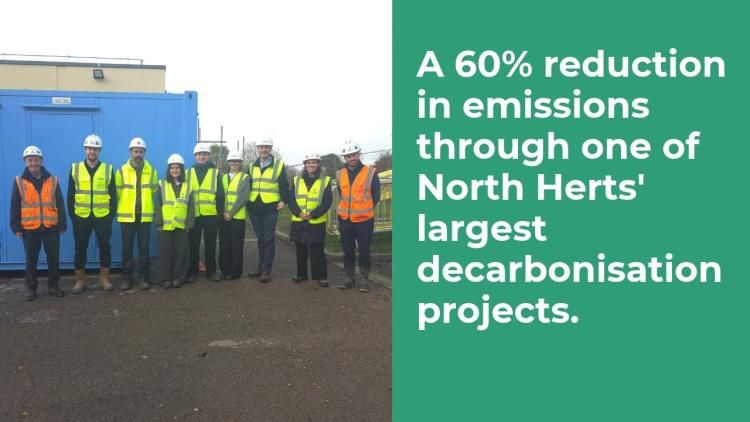
Our team members Natalie Hobbs, Tom Willink, Ian Rodger and Bianca Duca visited North Herts to find out more about the impacts and challenges around delivering the project.
Our team also got a chance to meet local leisure centre users talk about the impact of the changes to them.
The three sites at the centre of this initiative - Royston Leisure Centre, North Herts Leisure Centre in Letchworth and Hitchin Swimming Centre - were identified as priority for energy efficiency upgrades due to their energy demands, ageing heating infrastructure and disproportionate contribution to the council’s overall carbon footprint.
The council’s leisure centres account for 45 per cent of its total carbon emissions.
During our visit we toured Royston Leisure Centre, where works are complete.
Director of environment at North Hertfordshire Council, Sarah Kingsley said: “It’s not just about saving money on energy bills.
It’s about creating warm, comfortable spaces where people can come together, stay active and feel part of their community.
Leisure centres account for such a large proportion of the council’s emissions and decarbonising these sites represents a major step towards achieving our net zero ambitions.
It demonstrates the council’s commitment to sustainability and reflects the priorities of our residents, who care deeply about environmental issues.
A fabric first approach to decarbonisation
Taking a ‘fabric first’ approach at each site, work involved upgrading insulation, installing double glazing and improving the thermal performance of the buildings as a whole.
At all three sites ageing gas boilers were replaced with modern air source heat pump systems.
North Herts Leisure Centre, and Hitchin Swimming Centre, were being powered by 14-year-old gas boilers.
Royston Leisure Centre, which opened in 2005, was operating with an 11-year-old gas boiler. Royston now serves as the council’s flagship example of what this programme can achieve.
In addition to heat pump installations, solar photovoltaic panels have been installed at both Royston and North Herts Leisure Centres, providing on-site renewable electricity generation and contributing to measurable reductions in energy consumption.
Lighting upgrades and further building fabric improvements have also been implemented across all three sites to maximise overall efficiency gains.
Measurable environmental impact
Across all three sites, the upgrades are expected to deliver annual carbon savings of approximately 1,200 tonnes - the equivalent of removing dozens of petrol-powered vehicles from the road each year.
The council says it anticipates a reduction of around 60 per cent in emissions from the leisure centres themselves, with that figure expected to improve further as the national electricity grid continues to decarbonise over time.
Sarah also acknowledged the critical role that external funding has played in making the programme possible.
She said: “We couldn’t have delivered this project without Public Sector Decarbonisation Scheme funding.
“The council has invested significant capital of its own, but this funding has been critical to making the project a success.”
How local people are benefitting
During our visit we also heard how the programme has generated tangible benefits for the local community.
Following the completion of works at Royston Leisure Centre, membership numbers increased from 2,294 in April to 3,014 in October - an increase of 720 members.
Centre member Jim Davison talked to us about the impact of the changes for him.
He said: “Over the last few years, the centre has been transformed. The facilities are comparable to high-quality fitness centres you’d find in London, and they’ve made a huge difference to the local community.
Within the local community, the leisure centre is a fantastic asset.
Since the upgrades, it’s become an even better place for people to exercise, socialise and improve their wellbeing
Mr Davison also highlighted the broader social value of accessible, high-quality leisure provision.
He added “I use the gym to stay fit, maintain my health and, after spending so much time working from home, it’s also a great place to get out of the house and meet people.”
Progress across the programme
Whilst works at Royston Leisure Centre have been completed, progress continues across the remaining sites.
North Herts Leisure Centre in Letchworth has served the community since 1982 and includes a gym, swimming pools, a sports hall, squash courts, a sauna, and a steam room. Works have recently resumed on site after delays with the Distribution Network Operator (DNO).
The programme is on course for full completion by April 2027.
Works at Hitchin Swimming Centre, which provides year-round indoor and outdoor swimming facilities, also continue.
Looking ahead
Sarah explained the council's long-term vision for what success might look like.
She said: “Looking ahead, success for us over the next five to 10 years would be seeing these leisure centres become examples for other local authorities considering similar decarbonisation projects.”
The improvements are also expected to extend the operational lifespan of the buildings themselves, with enhanced thermal efficiency and insulation contributing to their long-term structural integrity.
The reduction in operating costs from lower energy consumption will, in turn, free up resources that can be reinvested in services for residents.
Through careful planning, significant investment and the effective use of government funding, the council is delivering facilities that are not only greener and more sustainable, but more welcoming, more capable, and better positioned to serve residents for decades to come.


