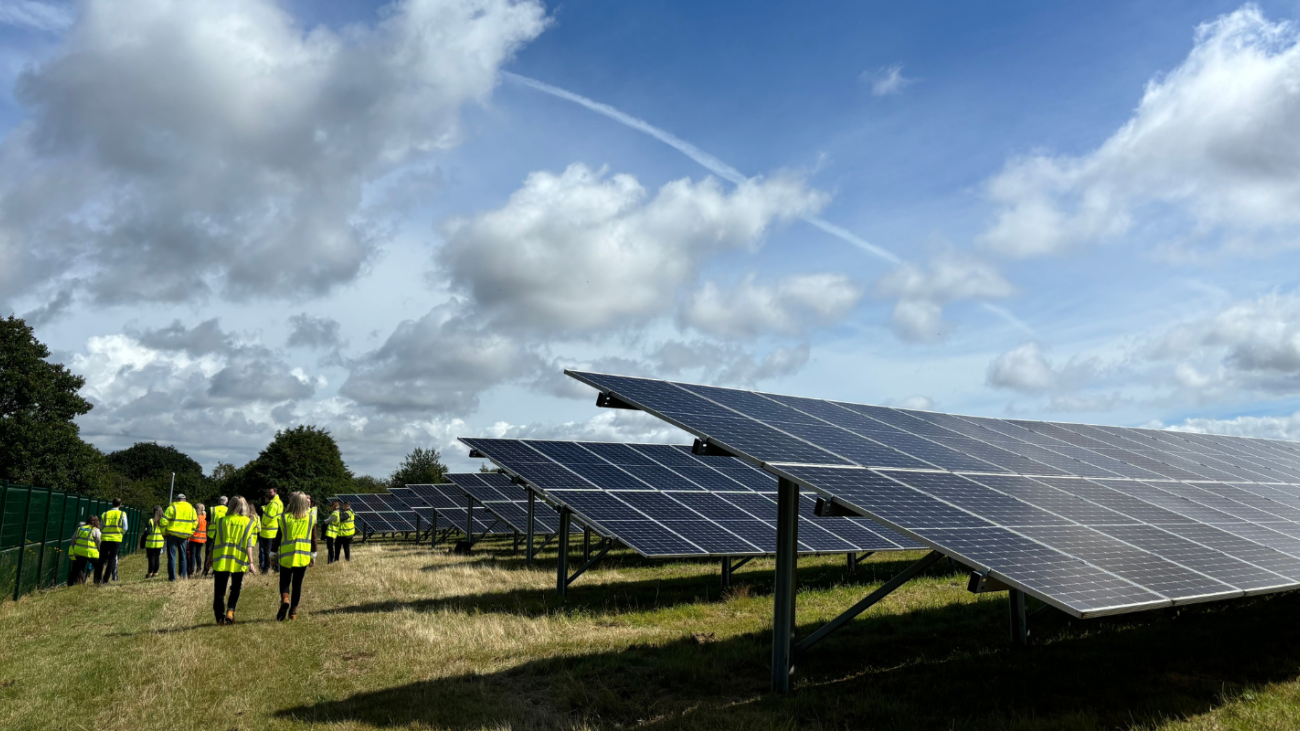
Solar’s rapid rise points to a brighter energy future, says Solar Energy UK chief
In episode 5 of Tomorrow’s Energy podcast, we learn that from rooftops to reservoirs, Chris Hewett sees expanding renewable generation as a route to lower bills and greater energy independence
Solar power is moving from an emerging technology to a central part of the UK’s energy future, according to Chris Hewett, chief executive of Solar Energy UK.
Speaking on episode five of Tomorrow’s Energy, Chris highlights the speed at which solar and battery technology has developed. He also talks about its growing role in cutting energy bills, strengthening energy security and supporting the UK’s transition to a more electrified economy.
He says: “The technology of solar roof technology is now very cost effective. It’s easy to deploy, it’s very quick to deploy.
“Paired with a battery, it’s becoming a very, very popular way to reduce energy bills, whether it’s in the home or in commercial buildings or public sector buildings.”
Chris, who has extensive experience working across energy policy and government, said the scale and pace of the transformation should not be underestimated.
He says: “It is the fastest growing energy technology in the history of humankind.”
Solar has moved rapidly from a technology that relied on government support to one that can increasingly stand on its own economically. Chris notes that the UK now has no subsidy for solar or batteries, yet the economics are strong enough for households, businesses and public sector organisations to invest.
“It’s a mature technology, which is deploying very, very fast across the world.”
The technology is also becoming increasingly versatile. Alongside conventional rooftop installations and solar farms, new applications are emerging, including floating solar.
“It’s a different type of way of generating power.” Floating solar involves panels installed on reservoirs, provide another way to make use of available space without competing directly with other land uses.
While still relatively niche in the UK, Chris believes it demonstrates the flexibility of solar technology.
That flexibility could become increasingly important as the wider economy moves towards electrification.
“We’re seeing electrification of transport; we’re seeing electrification of heat with heat pumps. The cheapest forms of generating electricity are now solar and wind in the UK.”
He estimates that around half of the UK’s electricity currently comes from renewable sources, with solar accounting for about seven per cent of generation over the year - up from around five per cent roughly 18 months earlier.
The trajectory, he suggests, points towards a much bigger role for solar in the years ahead. The Netherlands, for example, already generates around 20% of its national electricity from solar.
For the UK, however, expanding solar will require overcoming challenges including grid capacity, particularly for large rooftops such as warehouses, schools and hospitals.
Chris says progress is already being made, including through solar projects in schools, some supported by GB Energy as well as funding delivered by Salix, alongside private finance and asset-financing models.
“The economic case for putting solar and usually a battery on the side in most buildings is pretty strong.”
We’re seeing electrification of transport; we’re seeing electrification of heat with heat pumps. The cheapest forms of generating electricity are now solar and wind in the UK.
The economic case for putting solar and usually a battery on the side in most buildings is pretty strong.
Battery storage
Battery storage is becoming an increasingly important part of that equation. Falling battery costs mean households and businesses can store electricity generated during the day and use it when demand is higher.
“If you have a battery, then you can put it in the battery, you can save it and use it later.”
Chris believes that combination of solar and storage will also play a role in making energy prices more predictable and improving the UK’s resilience.
“You do have to have a longer-term mindset,” he says arguing that solar installations can provide electricity for decades once the initial investment has been made.
“What solar does, is guarantee that price for 20, 30 years, and that security, I think, is a really important part of the debate.”
A closer relationship with government
Chris’s influence extends beyond the industry itself. As the UK’s solar sector has expanded, so too has Solar Energy UK’s engagement with government and regulators.
“We have a much deeper partnership with government than we had perhaps, sort of, you know, seven or eight years ago,” he says.
Chris jointly co-chairs the Solar Council with Energy Minister Michael Shanks, bringing government and industry together to discuss how the UK’s solar ambitions can be delivered.
The organisation is also involved in developing the UK’s solar roadmap, with a target of more than 50GW of solar by 2030 - a goal Chris believes is “eminently doable.”
He said one of the industry’s priorities is ensuring policymakers and system operators understand just how quickly solar and battery technology is developing.
“I think it’s ensuring that there’s a real understanding amongst government and regulators of how quickly this technology is developing.”
That message is particularly important as energy security and independence become increasingly prominent policy priorities.
For Chris, solar is not simply a climate technology. It is also an important part of the UK’s long-term energy resilience.
“It’s the cheapest way to generate electricity in the UK, bar none, and that includes offshore wind,” he says.
He also pushes back against the familiar criticism that Britain is simply not sunny enough for solar. “It’s such a good technology. It even works in a UK climate,” he says.
Addressing concerns over solar farms
Chris acknowledges that some solar projects face opposition, including concerns around farmland and the impact on local communities. However, he argues that some of the criticism is based on outdated perceptions of the technology.
“There’s an awful lot of misinformation out there,” he said. He points to evidence suggesting that well-managed solar farms can provide benefits to the wider rural economy and biodiversity.
Landowners can use income from solar leases to reinvest in food production elsewhere on their holdings, while solar sites can incorporate wildflowers, hedgerows and other habitats.
Chris says surveys carried out by Solar Energy UK members in East Anglia found significantly higher bird numbers on some biodiversity-managed solar sites than on surrounding arable land.
He also acknowledges that the industry needs to do more to communicate those benefits, while stressing the importance of independent scientific evidence.
The next step: solar-powered transport
Looking further ahead, Chris sees solar becoming increasingly integrated with everyday life - including transport.
“I think if you’re not already driving an electric vehicle, I think you will be very soon,” he says.
For households with rooftop solar, the opportunity is particularly compelling: generate electricity at home, store it in a battery and use it to charge an electric vehicle.
“You are much more likely to have an electric vehicle if you have the opportunity to charge that at home because that's something you have free fuel for your fuel transport.”
Ultimately, Chris expects solar technology to become even more integrated into vehicles themselves.
Solar is not new, it is fast becoming part of everyday life and, with the right policy and investment, its role in the UK could grow dramatically over the next decade.
Listen now
Don’t forget to let us know what you think and if you have ideas for guests or other podcast suggestions, please contact us at podcast [email protected]
All episodes are available for streaming or download from your preferred podcast platform including Apple, Amazon and Spotify. The recordings are also available from our website