
Scheme:
Phase 3c Public Sector Decarbonisation Scheme
Technologies used:
Heat network, Air source heat pump, Thermal stores, Boilers
Region:
South East
Client type:
Local authority
Your partner for a low carbon future
Phase 3c Public Sector Decarbonisation Scheme
Heat network, Air source heat pump, Thermal stores, Boilers
South East
Local authority
carbon emissions reduced per year
reduced heating emissions
local jobs created in the first phase
jobs expected to be created by 2050
Heat networks are increasingly being positioned as an important part of the UK’s transition to a low-carbon energy system. Rather than requiring every building to install its own heating technology, a heat network supplies multiple buildings from one or more central sources through insulated underground pipes. This approach can be particularly effective in towns and cities where buildings with significant heat demand are located close together.
The experience of the Worthing Heat Network demonstrates how this model can work outside the UK’s largest cities. Developed and operated by low-carbon energy company Hemiko in partnership with Worthing Borough Council, the project is designed to provide low-carbon heat to public buildings, businesses and, over time, homes across the town.
At Salix we have supported Worthing Borough Council through the Public Sector Decarbonisation Scheme.
This case study draws primarily on our Tomorrow’s Energy podcast interview with Sarah Glaser of Hemiko, who discusses the rationale behind heat networks, the development of the Worthing project, its technical design, the challenges of construction and the longer-term potential for expansion.
According to Sarah, heat networks have an important role to play in three interconnected challenges facing the UK: decarbonisation, energy security and energy costs.
Heat is one of the most difficult parts of the energy system to decarbonise because buildings have traditionally relied heavily on gas boilers. A heat network provides an alternative by allowing heat to be generated centrally from lower-carbon sources and distributed to multiple users.
A network can begin with one heat source and incorporate additional sources as technology and local opportunities develop. Potential sources include air source, river source and other large heat pumps, energy from waste, industrial waste heat and heat recovered from data centres.
The government has identified significant potential for heat networks: its market overview estimates that heat networks could grow from supplying around 3% of UK heat demand to around 20% by 2050, with potential sector investment of up to £80 billion.
As Sarah explains, this makes heat networks more than simply a replacement for individual gas boilers. They can provide a platform that can evolve as new sources of low-carbon heat become available.
Hemiko has been working with Worthing Borough Council to develop the network, with the initial ‘spine’ running through the centre of the town. The first phase has connected or prepared connections for a number of civic and public buildings, including Worthing Town Hall, Worthing Hospital, Worthing Museum & Art Gallery, the Connaught Theatre, Assembly Hall and Portland House. The second phase is extending the network to Splashpoint Leisure Centre and the Pavilion Theatre.
Hospitals, theatres, leisure centres and council buildings have substantial and relatively predictable heat requirements, making them useful anchor customers around which a wider network can be developed. We visited the project to find out more. We also attended the official launch.
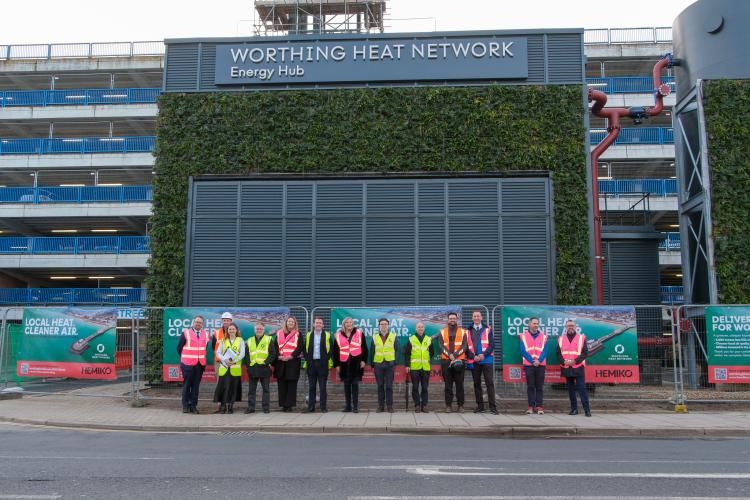
Outside Worthing Heat Network Energy Hub
Photo credit: Hemiko
At the centre of the Worthing network is a new Energy Hub in the town centre. The hub contains the equipment required to generate and manage heat for the network.
Initially, the system uses a 1.8 MW air-source heat pump, supported by thermal storage and backup boilers.
The air-source heat pump extracts heat from the outside air and transfers it into water. That hot water is then circulated through insulated underground pipes to connected buildings.
Inside each building, the existing gas boiler arrangement can be replaced or substantially reduced through the installation of a heat interface unit (HIU). It transfers heat from the network into the building’s heating and hot-water systems.
This means the job of generating and managing heat is moved away from individual buildings and managed centrally by the network operator.
One of the particularly important elements of the Worthing system is its thermal store.
This allows heat to be stored and used when required rather than necessarily being generated at exactly the same moment it is consumed.
This can provide two benefits.
The Worthing project has been designed as infrastructure for the future, rather than as a closed system serving only the buildings connected during the first phase.
In Tomorrow’s Energy, Sarah describes the concept as being similar to ‘building Legos’: the initial network creates a basic structure that can subsequently be extended through new branches and connections.
This has influenced the design of the underground pipework. Pipes can be sized with future demand in mind, while connection points can be incorporated so that new areas can be connected later.
The Worthing project is aimed at connecting every building in the town by 2050.
Another advantage of designing the network for expansion is that the heat source itself does not have to remain fixed.
Generally, it can use:
So, the pipes can remain in place while the sources feeding those pipes evolve.
The council estimates that the first phase of the Worthing Heat Network could reduce the town’s carbon emissions by approximately 3,000 tonnes per year, while connected buildings could reduce their heating emissions by around 90%.
This illustrates an important distinction between heat-network development and a conventional building-by-building retrofit programme: one central piece of infrastructure can potentially decarbonise multiple large buildings.
Our interview also highlights an issue that has become increasingly important since the UK’s energy price crisis: energy security.
Sarah argues that locally sourced heat can reduce customers’ exposure to international fossil-fuel markets. Gas prices can be heavily influenced by global events and international supply conditions. A heat network using locally available heat sources is less directly dependent on imported fossil fuels.
That does not mean heat networks are completely insulated from energy prices. Electricity is an important input for technologies such as large heat pumps, and network operators still face capital, maintenance and operating costs.
Delivering that infrastructure in a busy town centre is complex.
The Worthing project requires deep underground pipework to be installed through existing streets and public spaces. This has meant road closures, lane restrictions, temporary traffic management and disruption for businesses, residents and visitors.
The first phase began in summer 2024 and the main works concluded towards the end of 2025. The second phase began in January 2026 and is connecting Splashpoint Leisure Centre and the Pavilion Theatre.
Community engagement is key. Following feedback from residents, businesses and visitors, Hemiko and the council adapted their approach to the second phase in an effort to reduce disruption.
This directly reflects Sarah’s point in our interview; people are more likely to tolerate disruption if they understand why it is happening and what long-term benefits the infrastructure is intended to deliver.
The Worthing Heat Network is also intended to generate benefits beyond carbon reduction. The council estimates that the first phase created around 40 local jobs, while Hemiko expects the wider project to create up to 500 jobs by 2050.
The Worthing project is being delivered at an important point in the development of the UK’s heat-network market.
Historically, heat networks have not been regulated in the same way as the gas and electricity markets. That changed in 2026. Ofgem became the regulator for heat networks in Great Britain, with new requirements covering areas including service quality, billing, transparency, vulnerable consumers and security of supply. The consumer-protection regime began on 27 January 2026.
The new framework is intended to ensure that customers receive a reliable service, clear information and fair treatment while also providing a regulatory environment capable of supporting investment and market growth.
The government is also developing heat network zoning.
Heat networks have traditionally been associated with dense urban environments, yet Worthing demonstrates that the model can be applied in a coastal town by identifying suitable anchor buildings and building a network capable of expanding over time.
As Sarah Glaser explains in Tomorrow’s Energy, the long-term opportunity is to connect more and more buildings without requiring every customer to install and operate their own individual low-carbon heating technology.
For the UK as a whole, the case for heat networks is becoming stronger as the policy, regulatory and investment environment develops.


