
Recognition and improved efficiency from university upgrade

The latest article in our series celebrating the Low Carbon Skills Fund.
A university has won admiration from a leading trade body for its energy efficiency plans, which were developed with support from the Low Carbon Skills Fund.
Exeter University created its decarbonisation plans as part of its goals to rely less on fossil fuels and has now begun work to replace 29 gas boilers across two campuses.
The plans were shortlisted at the ADE Awards 2025, run by the Association for Decentralised Energy - a trade body championing low-carbon energy.
As part of our series celebrating successes of the Low Carbon Skills Fund, we look at how Exeter University used the grant to win further public funding - and admiration along the way.
The Low Carbon Skills Fund provided the university with the opportunity and mechanism to fully explore its options for meeting its ambition to decarbonise heat.
The university had already developed its Strategy 2030 with an aim to be a leader in sustainability and reduce emissions significantly by the end of the decade. But, having installed several air source heat pumps, the university wanted to better understand how to make wider energy efficiency savings across its estate.
So, it applied for the Department for Energy Security and Net Zero's Low Carbon Skills Fund, Phase 5, and was awarded £974,000 to come up with a heat decarbonisation plan. We delivered the funding on behalf of the department and worked closely with the university to deliver the project.
Under the plan, 14 buildings were able to operate at lower heating temperatures, and a Low Carbon Heat Network was designed for the Exeter St Luke's campus. Designs were also drawn up to connect ten large campus buildings to a low carbon heat network, which together account for a large amount of the university's annual fossil fuel use.
Andy Seaman, the University of Exeter's head of carbon and energy, said: “The Low Carbon Skills Fund provided the university with the opportunity and mechanism to fully explore its options for meeting its ambition to decarbonise heat. The funding and support from Salix have enabled the university to assess potential solutions aligned with its ambition and long-term vision of moving towards a zero-carbon campus.”
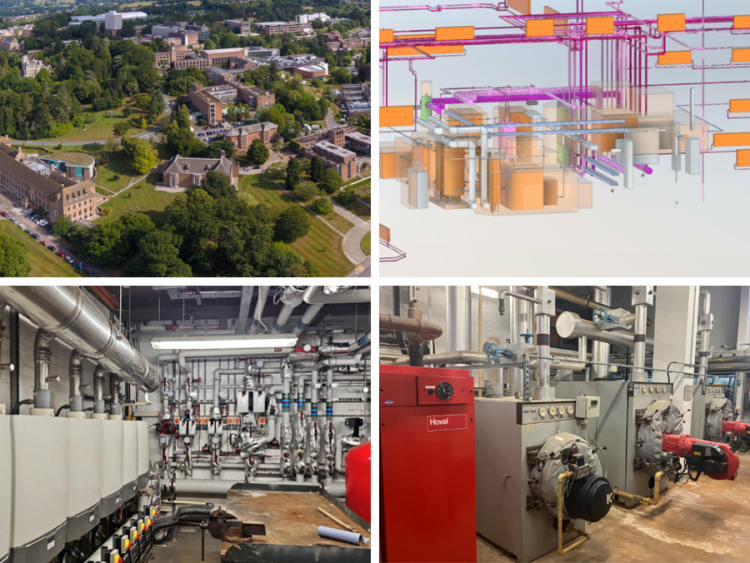
Image credit: Exeter University
In 2025, Exeter University was awarded £8.6 million from the Department for Energy Security and Net Zero's Public Sector Decarbonisation Scheme – again administered by us at Salix. This is to support a three-year project to replace 29 gas boilers across eight buildings at Exeter’s Streatham and St Luke’s campuses.
These upgrades will help move 17.5 per cent of the university’s heating systems to low carbon alternatives and save 875 tonnes in carbon emissions every year – the equivalent footprint of 300 large three-bed homes.
The eight buildings identified for transition to a low carbon heating solution under the Public Sector Decarbonisation Scheme funding are:
- Harrison and Kay Building, Amory Building, Forum Building and Holland Hall at Exeter’s Streatham campus
- Haighton Library, Exeter Medical School, St Luke’s Sports Centre and South Cloisters at St Luke’s campus
Jo Chamberlain, director of sustainability at the University of Exeter, said: “This investment represents a pivotal moment in our journey to decarbonise our campuses.
“By phasing out fossil fuel heating across key buildings, we are not only cutting emissions but demonstrating the kind of ambitious, science-led action required to address the climate crisis.”


