
Cardiff University visit highlights the impact of Welsh Government-funded decarbonisation projects
A visit to Cardiff University by our team has showcased how Welsh Government funding is supporting energy-efficiency improvements across the campus, while highlighting valuable lessons for the delivery of future decarbonisation projects.
As part of its work delivering funding on behalf of the Welsh Government, we visited Cardiff University to see firsthand how investment is being used to improve building performance, reduce energy consumption and support the university’s decarbonisation ambitions.
Our team members Rachael Holliday and Gbenga Adenaike met Alice Milanese, Cris Lewis, Tessa Lama and Nigel Griffin from Cardiff University.
Together they explored a range of projects supported through the Welsh Funding Programme and the Digarbon project, including heat pumps, solar photovoltaic (PV) panels, LED lighting, upgraded air handling systems and improvements to building insulation and windows.
Our teams at Salix have delivered the funding on behalf of Welsh Government.
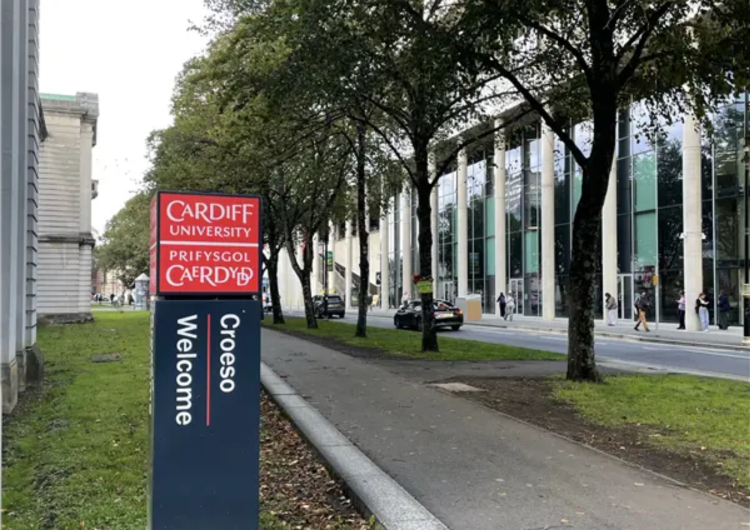
Photo credit: Salix Finance
Practical issues on a busy site
Wales programme manager Gbenga said: “The visit gave us a chance to discuss the practical realities of delivering energy efficiency measures across a complex university estate. It’s a busy place.
“It has involved commissioning new equipment to working within historic buildings. As well as this, the teams have had to encourage changes in everyday behaviour.
“The projects demonstrate why successful decarbonisation depends on more than technology alone.”
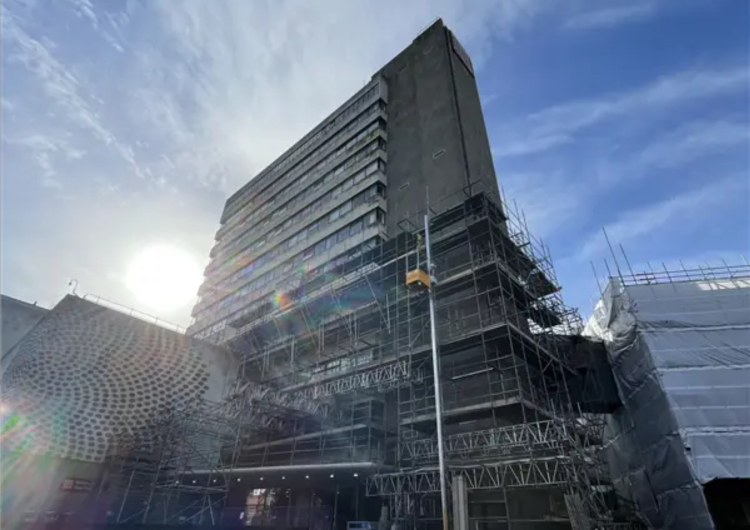
Photo credit: Salix Finance
The solar installation demonstrated the benefits of coordinating energy efficiency projects with maintenance. By installing the panels following a roof replacement, the university was able to align the two projects, helping to make the most of the opportunity.
Seeing the impact of investment first-hand
At the Arts and Social Studies Library, we saw a new LED lighting system installed with Welsh Funding Programme funding. Motion sensors and daylight controls automatically adjust lighting levels to reduce unnecessary electricity use, while a rooftop solar PV array of approximately 438 panels offers the potential to significantly reduce the library’s electricity demand.
Rachael said: “The solar installation demonstrated the benefits of coordinating energy efficiency projects with maintenance. By installing the panels following a roof replacement, the university was able to align the two projects, helping to make the most of the opportunity.”
Tessa Lama from the university explained that the library’s distinctive ceiling design presented challenges for the new lighting system, with additional lights required in some areas to achieve the necessary illumination levels.
The experience highlighted the importance of tailoring solutions to individual buildings and checking performance after installation.

The rooftop solar PV array of approximately 438 panels offers the potential to significantly reduce the library’s electricity demand
Photo credit: Salix Finance
Elsewhere on campus, improvements to an air handling unit serving the Sir Martin Evans and Cardiff School of Biosciences buildings demonstrated the potential for significant energy savings through carefully designed upgrades.
The replacement system uses four individual fan-and-motor assemblies rather than a single belt-driven fan. This allows the system to better match demand and continue operating if one fan needs to be replaced, improving both energy efficiency and operational resilience.
Nigel Griffin said: “This work has delivered one of our greatest energy savings per unit, demonstrating how targeted investment can deliver benefits beyond reduced energy consumption, including improved reliability and maintainability.”
Learning from the challenges of project delivery
The project underlined the importance of specifying equipment carefully, understanding the demands of the building and allowing sufficient attention to commissioning. It also highlighted the value of learning from existing installations when planning future upgrades.
Building constraints have presented further challenges at the Law and Tower buildings, where window replacements and associated improvements are being delivered through Digarbon.
Cris Lewis, Digarbon project manager, said: “These are set in a conservation area, so both buildings required careful consideration of planning requirements and appropriate replacement materials.
“As well as this, structural limitations, restricted access and the need to maintain building operations have also added complexity to the works.”
The replacement of existing single-glazed steel-framed windows with double glazed alternatives requires detailed design and coordination. Occupants in the Law Building will be decanted to alternative spaces during construction and at Tower Building they will move to alternative spaces when works are being carried out on their floors.
Gbenga said: “These projects illustrate the importance of early planning, collaboration with contractors and building managers, and engagement with planning authorities and building users.
“They also demonstrate how funding for decarbonisation can support wider improvements, with the university planning to fund the installation of thermostatic radiator valves internally as part of its wider programme of works.”
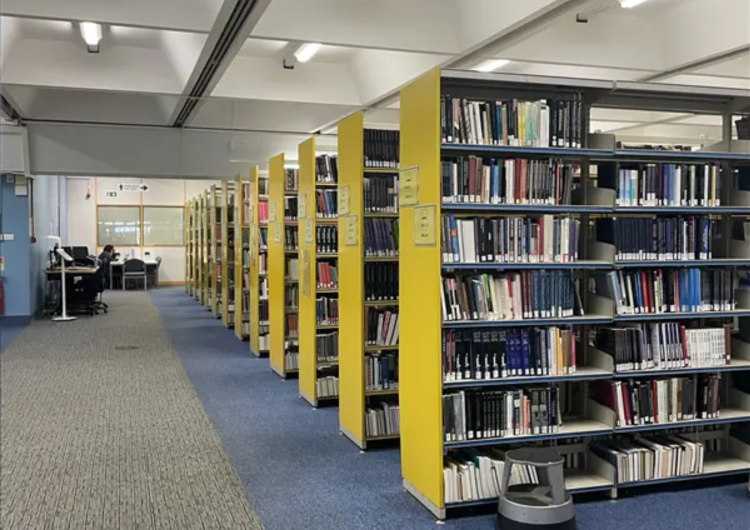
The new LED lighting at the Arts and Social Studies Library at Cardiff University
Photo credit: Salix Finance
Technology and behaviour must work together
A key theme throughout the visit was the role of the building and its users in achieving the full benefits of this energy efficiency work.
At the Main Building, upgrades to chemistry laboratory fume cupboards are helping to reduce the energy required to extract and condition air. Previously, the cupboards operated at full capacity continuously. The upgraded systems reduce airflow when the sash is lowered, helping to limit unnecessary energy use.
However, the expected savings depend partly on how the equipment is used. Keeping the sash lowered when a fume cupboard is not in use is essential to achieving the intended benefits.
Similar lessons emerged from the installation of intelligent lighting controls at the Arts and Social Studies Library. Initially, some occupants assumed that lights switching off automatically indicated a fault, highlighting the need for clear communication and guidance when new technologies are introduced.
These examples demonstrate that behaviour change must be considered alongside technical improvements. Engaging building users, explaining how new systems work and encouraging good practices can help ensure that investments deliver their intended energy savings.
Sharing lessons to support future projects
Rachael said: “It’s very clear that delivering improvements across a live university campus requires careful coordination.
“The teams needed to consider construction noise, access, temporary relocations and changes to familiar building systems can all affect students and the teams and hence project delivery.”
The visit also highlighted the importance of maintaining regular communication with building users, facilities teams and contractors, ensuring that people understand what is changing, why the work is necessary and how they can help support its success.
It also reinforced several wider lessons for future decarbonisation programmes: the importance of selecting technology suited to each building, coordinating improvements with planned maintenance, prioritising commissioning and performance verification, and considering long-term reliability alongside energy savings.
Turning funding into lasting impact
The Cardiff University visit demonstrated the breadth of opportunities available to improve energy efficiency across a university estate, from renewable energy generation and modern lighting controls to heating, ventilation and building fabric improvements.
It also showed that achieving lasting results requires a joined-up approach, combining investment in appropriate technology with effective project management, robust commissioning and engagement with the people who use buildings every day.
Thank you to Cardiff University for hosting our team for an exceptional day of learning.


