
Coleg Cambria’s solar project highlights Wales’ drive towards a low-carbon future
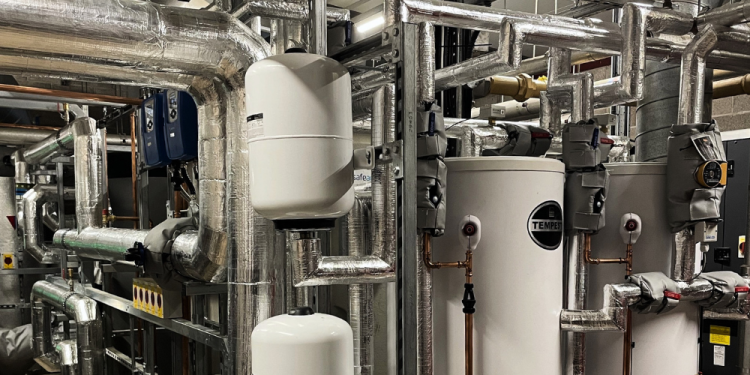
A visit to the college’s Deeside and Yale sites provided an insight into how renewable energy, smarter energy management and green skills are coming together across the estate
A visit to Coleg Cambria’s sites in North East Wales has provided an insight into the college’s ongoing work to reduce emissions, improve energy efficiency and prepare learners for a low-carbon economy.
The visit included time at the college’s Deeside site, where a major solar photovoltaic (PV) project is being developed at the Engineering Centre of Excellence, as well as the Yale site, where work connected to the college’s wider decarbonisation programme is helping to turn its sustainability ambitions into practical action.
The solar project at Deeside is being supported by £261,655.42 of Welsh Government funding through the Wales Funding Programme, delivered by our teams at Salix and supported by Great British Energy.
The project is expected to generate annual financial savings of around £22,214 once operational, while reducing the college’s reliance on grid electricity and helping to cut Scope 2 carbon emissions.
Team members job title Libby Checketts from our energy carbon and technical team and client support officer Kely Togba led the visit on behalf of Salix.
During the visit, Libby and Kely met Chris Bartlett, director of KHS Group; Steffan Cook, development manager at Welsh Government Energy Service and Sophie Hughes-Saunier, sustainability and environmental specialist.
Discussions with the team highlighted that the project is about more than installing solar panels. It forms part of a broader approach to understanding how the college uses energy across its estate and identifying where improvements can have the greatest impact.
The college is committed to improving its environmental performance and fundamentally changing the way we operate to become a sustainable, low-carbon organisation. The college can now accelerate its decarbonisation programme and install roof-mounted solar PV panels to generate clean energy.
At the Deeside Engineering Centre of Excellence, the scale and nature of the building make it an important part of the college’s energy requirements.
The planned solar installation will allow the college to generate more renewable electricity on site, helping to offset some of the electricity it would otherwise need to draw from the grid.
The project also includes the introduction of smart energy monitoring across suitable roofs at sites around the college. The additional data will give estates teams a clearer picture of where and when energy is being consumed, helping to identify inefficiencies and inform future decisions about energy use.
That emphasis on data was one of the key themes emerging from the visit.
Libby said: “It was fascinating to see the project first hand and also to understand the importance of the data.
“Generating renewable energy is one part of reducing emissions but understanding how buildings operate and where energy is being used is equally important if savings are to be sustained over the longer term.”
The visit to the Yale site also provided an opportunity to learn more about the college’s wider decarbonisation activity, including the role of Digarbon 2 in supporting projects that translate environmental ambitions into measurable action.
For Coleg Cambria, the work sits within a much broader sustainability strategy. Alongside investment in its buildings and energy infrastructure, the college is also developing green skills provision, supporting student-led environmental activity and using initiatives such as Streamlined Energy and Carbon Reporting (SECR) to understand and manage its carbon footprint.
The connection between the college’s buildings and its curriculum is particularly significant. As a major further education provider, Coleg Cambria is not only seeking to reduce the environmental impact of its own operations but is also in a position to expose learners to the technologies, skills and approaches that will increasingly be required across the economy.
The Engineering Centre of Excellence at Deeside provides a natural setting for that connection. Renewable energy infrastructure becomes part of the working environment in which students are learning technical and engineering skills, helping to demonstrate how decarbonisation is being applied in practice.
Kely added: “It’s a very ambitious project with a great team behind it. It offers a practical example of the role education institutions can play in the transition to a low-carbon economy, both by reducing emissions from their own estates and by helping to develop the workforce needed to deliver further change.
“Our visit has helped us more clearly understand how solar installation represents one part of a much larger journey for Coleg Cambria. From renewable generation and smart energy monitoring to green skills and student engagement, the college is looking at sustainability as an ongoing programme rather than a single project.
“It’s a highly inspiring project.”
As the solar installation progresses towards completion, the focus will be on seeing the technology move from plans on paper to an operational part of the college’s estate, while providing a visible example of how investment in decarbonisation can deliver environmental, financial and educational benefits.
Thank you to the Coleg Cambria team for hosting our Salix team and we look forward to following your energy efficiency journey.


