
Transforming a historic icon: Magdalen College’s path to a low-carbon future
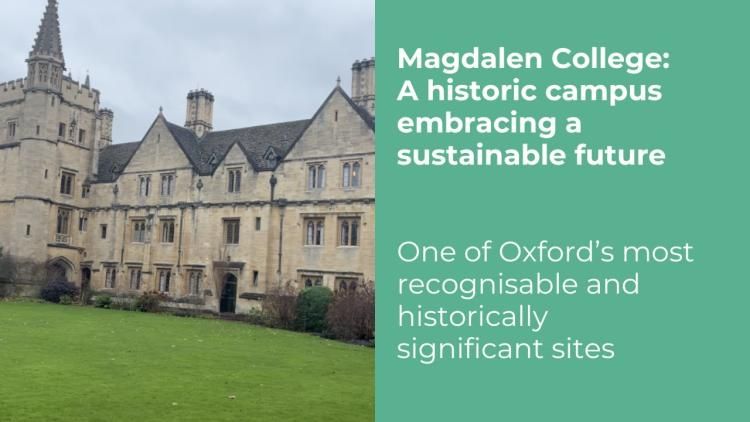
We went behind the scenes at iconic Magdalen to explore how it is blending innovation, sustainability and heritage stewardship
Oxford’s historic colleges are accelerating their journey to net zero with support from the Public Sector Decarbonisation Scheme, demonstrating how centuries-old buildings can be sensitively transformed for a low-carbon future.
Across the university, we have been working with colleges to turn their ambitious net zero carbon goals into reality.
As part of this work, our teams recently visited Brasenose College and Magdalen College - two landmark institutions that have undertaken major decarbonisation projects with scheme funding.
As part of our two-part series, today we’re focusing on Magdalen – watch our video and find out more about the vision behind the energy efficiency works.
Our visit offered a unique opportunity to go behind the scenes, hear directly from college leaders, and see how each site is balancing the demands of preserving heritage with the need for modern, energy-efficient infrastructure.
Oxford’s wider vision for a low-carbon estate
The University of Oxford has committed to a comprehensive decarbonisation strategy focused on retrofitting existing buildings, integrating renewable energy systems, and adopting Passivhaus principles in new construction.
Initiatives including Oxford Net Zero, the ZERO Institute and the Oxford Offsetting Principles continue to position the university as a global leader in climate research and carbon reduction.
Within this context, the colleges, custodians of some of Britain’s most treasured architectural heritage, are working to ensure their historic estates remain resilient, functional, and sustainable long into the future.
Magdalen College: A historic campus embracing a sustainable future
At Magdalen College it seeks a 50% decline in net carbon by 2030 and towards net zero by 2040 with a net gain in biodiversity by 2030.
The college says it is committed to reducing its impact on the environment and enabling its members to create a sustainable world through their actions and influence.
Magdalen is one of Oxford’s most recognisable and historically significant sites. It secured Phase 3c Public Sector Decarbonisation Scheme funding to deliver a range of energy-efficiency improvements and renewable energy integrations.
The funding, from the Department for Energy Security and Net Zero, is delivered by our teams at Salix.
The college’s wider sustainability policy includes commitments to upgrading buildings, managing its extensive grounds responsibly, and protecting biodiversity across its deer park and iconic gardens.
During the visit, we met Magdalen College surveyor Robert Langley, Original Field Architecture and Landscape director Andrew Dawson, and Bill Watts who is a director at Max Fordham. They have all been instrumental in delivering the decarbonisation work.
Their projects include upgrades to student accommodation, including Old School House, Longwall Cottage and fellows’ accommodation at Cowley Place. These improvements are designed to ensure historically significant buildings are more comfortable and energy-efficient for students, academics and staff.
Robert said: “Preserving our historic estate while transitioning to a sustainable energy future is both a challenge and a responsibility we take seriously.”
In our video Robert, Andrew and Bill explain the importance of keeping planet, heritage and modernisation in mind.
Together the teams have worked closely to achieve results.
Andrew said: “As architects we are privileged to act as custodians of buildings that carry such significance.
“Decarbonisation forms an essential part of this work, allowing these places to be upgraded for their intended use and safeguarded for the generations who will follow.”
Decarbonisation forms an essential part of this work, allowing these places to be upgraded for their intended use and safeguarded for the generations who will follow.
Bill added: “We’ve enjoyed collaborating with a dedicated client and talented architects from the inception of the project, and it’s great to see it progress to delivery.
We’re now working hard to optimise the system so the college can gain the maximum benefit from the government funding and its own investment.
Collaboration for a sustainable future
At Salix we continue to work across the public sector delivering Phase 4 of the Public Sector Decarbonisation Scheme up until 2028, funding energy-efficiency improvements and low-carbon heat upgrades across public buildings.
Our client support officer Claudia Head said: “It’s inspiring to see how colleges like Magdalen and Brasenose are blending tradition with innovation. Their commitment to sustainability shows what can be achieved when history, science and modern engineering come together.”
Colleague Anna Kuratnikova added: “It’s thrilling to visit Magdalen and to see this progress, and to witness heritage being safeguarded for generations to come through modern energy-efficiency measures.”


