
Scheme:
Phase 1 Scotland’s Public Sector Heat Decarbonisation Fund
Technologies used:
Solar PV
Region:
Scotland
Client type:
Higher education institution
Your partner for a low carbon future
Phase 1 Scotland’s Public Sector Heat Decarbonisation Fund
Solar PV
Scotland
Higher education institution
Total project cost
Estimated annual carbon savings
Abertay University is reducing carbon emissions across its estate through a long-term decarbonisation strategy focused on cutting energy demand and adopting low-carbon heating.
Supported by Phase 1 of Scotland's Public Sector Heat Decarbonisation Fund, the university installed a solar PV array on its library building to generate renewable electricity and support wider energy-efficiency improvements across campus. The project forms part of a long-term plan to develop a low-carbon heat network serving both the university and, potentially, the wider city of Dundee.
As a university committed to innovation and social responsibility, we are delighted to secure support through Phase 3 of Scotland’s Public Sector Heat Decarbonisation Fund.
This investment will enable us to take another significant step in decarbonising our estate, reducing emissions and creating a more sustainable environment for future generations of students and staff and the local community.
Securing this funding is a vital component of our wider estates strategy to develop a low-carbon heating solution for our campus with the potential to catalyse a city-wide heat network for Dundee, linking to our civic partners.
We are proud to be working alongside partners across Scotland to support the transition to net zero, and we thank the Scottish Government and Salix for their continued commitment to helping public sector organisations deliver meaningful climate action.
✅ Solar PV array installed on the roof of the library building
✅ 13% reduction in energy use in the first three months of operation
✅ Now able to monitor and report on live energy consumption
✅ Supports Abertay University's low-carbon energy infrastructure plan
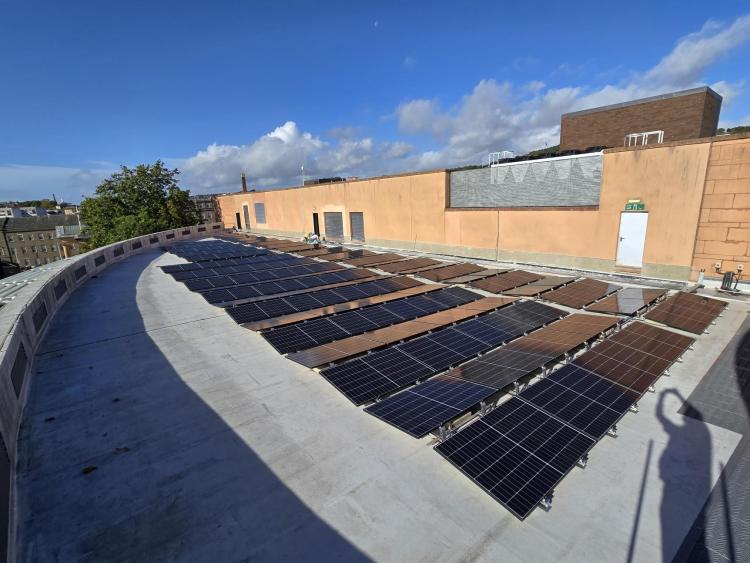
Photo credit: Abertay University
As part of its estates strategy, Abertay University developed a low-carbon energy infrastructure plan running from 2021 to 2030. The strategy is centred on creating a low-carbon heat network for the campus, with the ambition that it could act as a catalyst for a wider heat network serving the city of Dundee.
Its decarbonisation strategy addresses energy demand management on campus, and the university identified a number of measures to reduce energy consumption, one of which is the provision of a new solar PV array on the roof of its library building.
The project was developed and designed in collaboration with key supply chain partners and their solar PV specialists.
Reducing campus energy demand
The library solar PV installation is part of a larger plan to reduce demand across campus. The BMS upgrade to the library was completed in November 2025 as the first phase of this energy reduction project. The upgraded controls and associated controls strategy have delivered a 13% reduction in energy use in the first three months of operation. The university anticipates a further 12% saving from the PV installation. The university can now monitor and report on live energy consumption through the BMS and will evidence predicted vs actual performance on the PV array in the months after project completion.
The system will also integrate occupancy-sensing data from the university's facilities management platform, Planon, helping to optimise energy use based on building occupancy.
The challenge
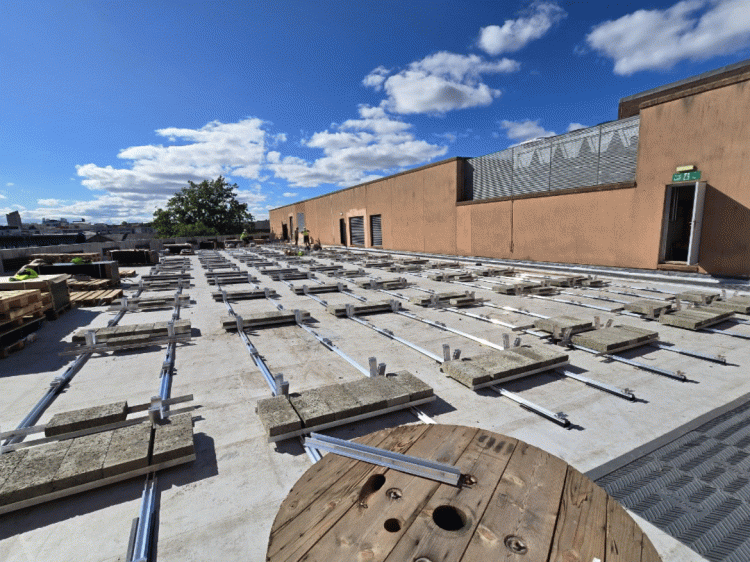
Photo credit: Abertay University
The solar PV installation was completed without disrupting day-to-day operations, allowing the library to remain fully open throughout the works. The university maintained regular communication with building users through live-stream updates, ensuring staff and students remained informed about progress and site safety arrangements.
The project supports Abertay University's wider decarbonisation programme by reducing demand for grid electricity and contributing towards long-term carbon reduction goals. Combined with recent building management system upgrades, the project is expected to improve energy performance and provide valuable data to support future decarbonisation projects across the estate.
The project demonstrates how targeted renewable energy investment can support wider estate decarbonisation plans while maintaining operational continuity for students and staff.
Benefits for students, staff and the university
The university reported that the application process and engagement with Salix were professional and straightforward throughout the project.
The project also benefited from being part of a wider programme of improvements within the library, enabling project teams and contractors to mobilise efficiently and coordinate works effectively.
Following the solar PV project's success, Abertay University secured further funding through Phase 3 of Scotland's Public Sector Heat Decarbonisation Fund.
The next phase of work will replace gas boilers serving the library with air source heat pumps, supporting the university's long-term ambition to create a low-carbon campus energy network. The project is due to commence in October 2026 and be completed in March 2027.


