
Cranfield’s net zero ambition accelerates as team visits major decarbonisation works
Powering ahead to 2030 with vision and innovation taking centre place
Cranfield University’s journey to net zero is gathering pace - and a recent site visit revealed just how much progress is already underway.
Our Salix delivery team members Robert Throsell and Marcus Tang visited the Bedfordshire campus to see first-hand how the university is transforming its energy infrastructure, supported by millions of pounds from the Public Sector Decarbonisation Scheme.
The university has secured £7,825,344 through Phase 3c of the scheme for its latest programme of works, building on a previous £4,993,701 award through Phase 2. The university also received £11,279,371 grant in Phase 3a and £3,661,769 in Phase 3b.
Together, the funding is driving a step change in how the campus is heated and powered - replacing fossil fuels with low-carbon alternatives and modernising energy systems across the estate.
From gas to ground source: change in action
During the visit, the team toured residential buildings where air source heat pumps have already replaced traditional gas systems as part of the Phase 2 project. These installations are now providing efficient, low-carbon heating for student accommodation, a visible sign of Cranfield’s transition away from fossil fuels.
They also visited one of the most striking developments on site: boreholes being drilled 150 metres underground to power a new 0.5 MW ground source heat pump and 1 MW air source heat pump at the campus energy centre. Once complete, the system will significantly reduce emissions and further expand the university’s district heating network.
At Fedden House, home to postgraduate students, work is underway to connect the building to the existing on-site heat network offering another key step in creating a more resilient, low-carbon campus-wide heating system.
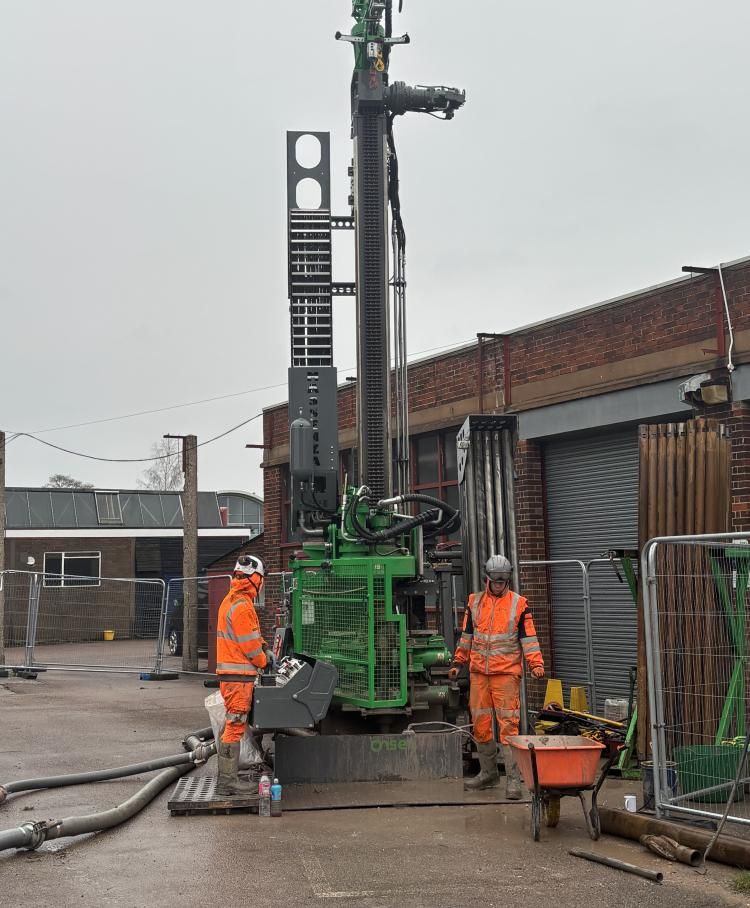
Drilling taking place on site at Cranfield University
Photo credit: Salix Finance
“It’s been non-stop - and it’s exciting”
Head of development and projects, Tracy Flynn, spoke about the pace and scale of change taking place across the university.
She said: “It’s been non-stop at Cranfield as we work towards our net zero target.
“Thanks to the Public Sector Decarbonisation Scheme funding, we’ve been able to accelerate plans that would otherwise have taken much longer.
“We’re replacing fossil fuel systems, installing large-scale heat pumps for district heating, upgrading lighting and improving our buildings’ performance. It’s not just about meeting targets, it’s about future-proofing the campus.”
Alongside heating upgrades, Cranfield has expanded its solar generation to around 2.4 MW, including extending its solar farm and installing panels on a disused car park. Improvements to insulation, airtightness and building energy management systems are also cutting energy demand across the estate.
On track for 2030
Energy and environment manager at the university Gareth Ellis, highlighted the strategic approach behind the programme.
He said: “We’ve been able to combine grant funding with loan investment to really move our journey forward.
“We’re still firmly on track to achieve net zero carbon emissions by 2030.
“The transition away from gas heating has become a priority in recent years, and Public Sector Decarbonisation Scheme funding has been instrumental in making that happen. Projects delivered through earlier phases are already expected to save around 3,500 tonnes of CO₂, and the latest 3c funding will take us even further.”
The university’s Carbon Management Plan sets out a pathway to reduce Scope 1 and 2 emissions from just under 9,000 tonnes of CO₂ in 2022/23 to around 2,000 tonnes by 2030/31 - with further renewable energy generation and infrastructure upgrades planned to close the remaining gap.
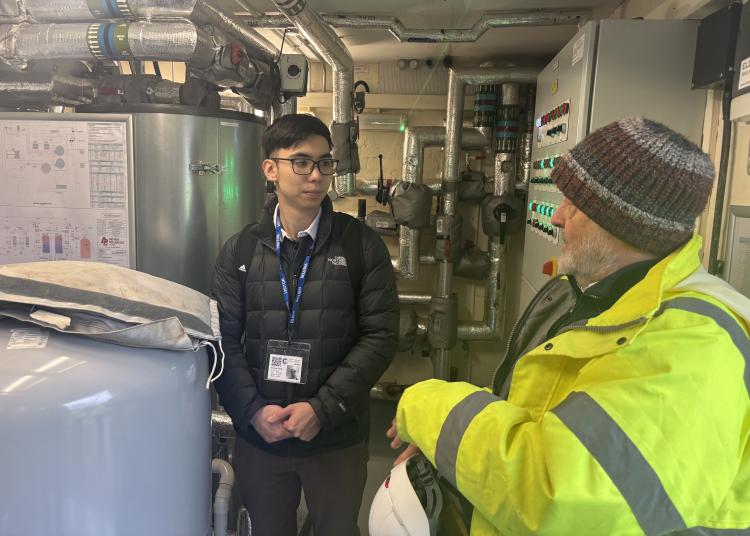
Salix's client support officer Marcus Tang discusses the project on site
Photo credit: Salix Finance
“You can feel the momentum”
For Robert Throsell, seeing the work up close brought the scale of Cranfield’s ambition into sharp focus.
He added: “You can really feel the momentum across the campus.
“Seeing boreholes being drilled 250 metres into the ground and walking through accommodation already heated by air source heat pumps shows this isn’t just a strategy - it’s happening now.
“What’s impressive is the whole-system approach. From solar expansion to heat networks and ground source technology, Cranfield is putting all the building blocks in place to make net zero by 2030 achievable.”
With major infrastructure projects underway, renewable energy expanding and emissions falling, Cranfield University is demonstrating how targeted public sector investment can unlock rapid, large-scale decarbonisation - and turn net zero ambition into visible action.
Colleague Marcus Tang said: “From a Salix perspective, it’s fantastic to see Public Sector Decarbonisation Scheme funding translating into real, tangible infrastructure on the ground.
“Cranfield is demonstrating exactly what the scheme is designed to do, accelerate decarbonisation, deliver measurable carbon savings, and create long-term, sustainable change.”
Thank you to the team at Cranfield for hosting the visit and sharing your story.


