
Cambridge college to cut energy bills by more than £11,000 a year through major decarbonisation upgrade
We visit a historic college and find out how it is modernising its energy bringing comfort to its students with support from the Public Sector Decarbonisation Scheme
Energy bills at one of the University of Cambridge’s oldest colleges are set to fall by more than £11,000 a year following a major investment in low-carbon heating and energy efficiency.
Peterhouse, the University of Cambridge’s oldest college, secured £565,513 in grant funding through Phase 3c of the Public Sector Decarbonisation Scheme to transform its Cosin Court student accommodation block.
The project is being delivered in partnership with our team at Salix, which manages the scheme on behalf of the Department for Energy Security and Net Zero.
The funding is enabling the college to modernise parts of its historic estate while supporting the University of Cambridge’s ambitious net zero strategy.
The university has committed to achieving net zero carbon emissions across its estate by 2038, with a strong focus on eliminating fossil fuel heating, improving building fabric performance, and increasing on-site renewable energy generation.
Salix colleagues programme coordinator Hira Raashid, client support officer Altyn Timraliyeva and energy and carbon analyst Olivia Kowalczyk visited the Cosin Court site to review progress and discuss next steps for decarbonisation across the wider university estate.
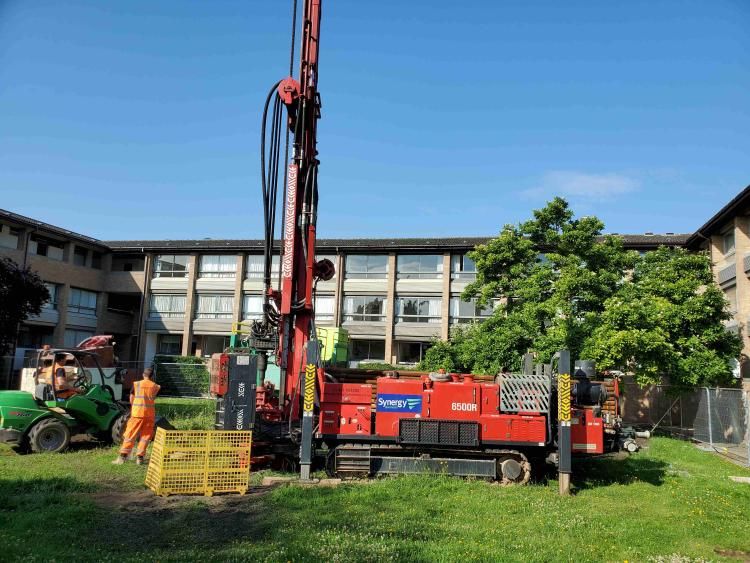
Undergoing work at Peterhouse, The University of Cambridge's oldest college
Photo credit: Peterhouse, University of Cambridge
The visit provided an opportunity to see how multiple low-carbon technologies are being integrated within a sensitive historic and residential setting.
The project centres on a comprehensive upgrade of the building’s heating and energy systems. Ageing fossil-fuel boilers have been removed and replaced with a high-efficiency ground source heat pump system.
The installation required the drilling of 28 boreholes, carefully designed and sequenced to minimise disruption to students and neighbouring properties while delivering a long-term, low-carbon heat source for the building.
Alongside the heating upgrade, extensive energy efficiency improvements have been carried out to reduce heat demand and improve comfort for residents.
These include the installation of double glazing, internal dry wall lining to improve thermal performance, floor insulation, and additional loft insulation. Solar photovoltaic panels have also been installed to help offset the increased electricity demand associated with the heat pump system, further reducing operating costs and carbon emissions.
Together, the measures are expected to cut carbon emissions by 97.32 tonnes per year and reduce annual energy costs by approximately £11,694, while significantly improving the resilience and sustainability of the building.
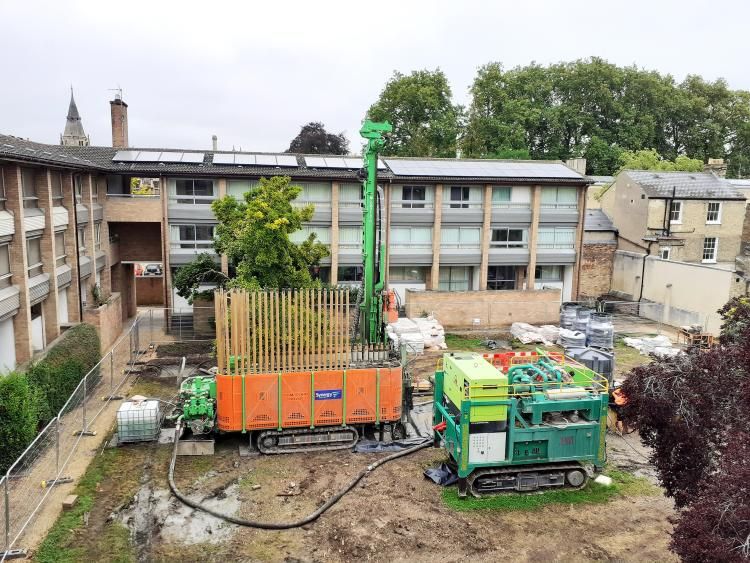
Construction teams at Peterhouse
Photo credit: Peterhouse, University of Cambridge
Peterhouse project manager at the University of Cambridge, Leon Waldock, met with our team during the visit and spoke about the challenges and opportunities presented by the project.
Leon said: “Peterhouse is aiming to reaching net zero by 2038, in line with the wider University of Cambridge vision, and we recognise that achieving this will require a broad, long-term approach across our estate.
“Many of our buildings are historic, which brings added complexity, but it also makes it even more important that we invest wisely and sensitively.
“This project at Cosin Court has enabled us to remove fossil fuels from a key student accommodation block, significantly improve the building fabric, and put in place modern, efficient systems that will serve the college well for decades to come.
“It also gives us confidence as we look ahead to future phases of decarbonisation across Peterhouse, knowing that these solutions can work even in challenging environments.”
During the visit, our Salix team toured the site to see how the different technologies work together as a single system, from heat generation and distribution through to on-site electricity generation and energy efficiency improvements.
Programme coordinator Hira Raashid said: “This project is a great example of what can be achieved when there is a clear vision and strong collaboration. It’s a real credit to the college teams for having the ambition to move this project forward and tackle the technical and logistical challenges head-on.
“By taking a fabric-first approach and pairing it with low-carbon heating and renewables, Peterhouse is making meaningful progress towards its net zero goals while also delivering tangible benefits for students and the wider estate.”
Client support Officer Altyn Timraliyeva added: “There is nothing more valuable than meeting the people behind these projects and seeing the work first-hand.
“Site visits like this show how much passion, expertise and determination goes into delivering successful decarbonisation schemes. Everyone involved has worked incredibly hard to overcome the inevitable challenges, and the results speak for themselves. Well done to the whole team.”
Our teams at Salix continue to deliver the Public Sector Decarbonisation Scheme on behalf of the Department for Energy Security and Net Zero. We are now supporting delivery under Phase 4 of the scheme, with funding allocated to projects running until 31 March 2028.
Peterhouse is one of several Cambridge colleges to benefit from the Public Sector Decarbonisation Scheme funding in recent years. Other participating colleges include Queens’ College, St Catharine’s College, and Gonville & Caius, as the university collectively accelerates progress towards its net zero ambitions.
Thank you to Cambridge for hosting our visit and we look forward watching your journey as you progress towards your net zero goals.


