
Major ground source heat project at London hospital moves into ‘test’ phase’
The University Hospital Lewisham initiative is predicted to save 4,000 tonnes of carbon emissions a year
An innovative London project to install a ground source heat pump at a major hospital has started and moved into its ‘test phase’.
The project at University Hospital Lewisham has been hailed a ‘once in a generation sustainability project’ and is supported by the Public Sector Decarbonisation Scheme.
Our teams at Salix are working closely with the Trust to deliver the ambitious project.
The ground source heat pump system at the hospital is replacing the 1970s gas-fired boilers that currently heat the site, modernising the heating system.
The heat pump will use low-carbon energy by drawing on groundwater from the chalk aquifer beneath neighbouring Ladywell Fields and then returning it back underground.
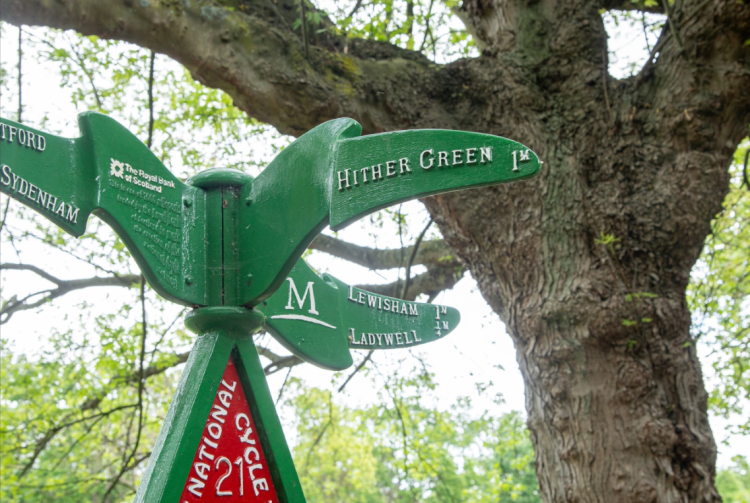
Photo credit: Lewisham and Greenwich NHS Trust
We are proud to deliver the Public Sector Decarbonisation Scheme and to stand alongside Lewisham and Greenwich NHS Trust on this ambitious and complex journey.
Drilling the boreholes
An initial study, which has included engagement with both the Environment Agency and Thames Water, has identified that the hospital and Ladywell Fields are well situated for this type of project.
The first phase begins on Wednesday 2 June and will involve drilling test boreholes, in the north and south end areas of the park.
Our Salix director of public sector decarbonisation, Ian Rodger said: “We are proud to deliver the Public Sector Decarbonisation Scheme and to stand alongside Lewisham and Greenwich NHS Trust on this ambitious and complex journey.
“The NHS has set bold and vital net zero targets, and by cutting carbon emissions, the Trust is not only creating a safer, cleaner environment for patients, visitors and staff today, but also shaping a healthier, more hopeful future for our planet and for generations yet to come.”
How it works
The aquifer beneath the park is essentially a big rock with lots of fractures in it that are full of water, and this phase is just to prove we can extract and return enough water to make the heat pump system viable.
The Trust has completed several surveys covering: groundwater, arboriculture (trees/roots/plant life) and ecology (animal/wildlife environment) to ensure minimal impact to the park. The popular park will remain open during the work.
The test phase will involve drilling two sets of boreholes, each comprising one deep borehole and one shallower monitoring borehole (four boreholes in total).
One set of boreholes will be located in the open field area north of the playground, with the second set at the southern end of the park. These locations were selected to minimise impact on tree root zones.
Next steps
If the data collected during this initial testing phase, scheduled to finish on 11 August, proves the scheme is technically viable, the project will work towards a second phase that would require additional drilling of up to 6 further boreholes, again, with works restricted to small, specific areas.
Park users will see little impact of the work or boreholes, except for a small access hatch, about the size of a standard drain cover. Even this will be camouflaged from view and local residents’ group, ‘Friends of Ladywell Fields’ are being involved in the discussions around the scheme.
Work will then focus on the infrastructure on the hospital site itself, removing old boilers and pipework and replacing them with a new network and installing the heat pump.
All works are expected to be completed in summer 2028 and once installed, the new, more efficient system is projected to save 4,000 tonnes in carbon emissions a year which will improve air quality in the local area.
The Trust was successfully awarded £17,790,274 through the Public Sector Decarbonisation Scheme, delivered by our Salix teams, and this is supplemented by the Trust, which will total a £25 million investment.
Chief strategy and transformation officer & deputy CEO at the Trust, Dr Neil Goulbourne, said: “Climate change is a real and pressing public health challenge.
“It exacerbates health inequalities, places additional pressure on our services and disproportionately affects the most vulnerable in our communities.
“The actions we take moving forward as a Trust, to reduce our emissions and costs, will make a very meaningful difference to our service users, local community and our colleagues both now and for future generations.”


