University of York geothermal milestone highlights Salix’s role in pioneering clean heat project
Latest annual project report recognises Salix’s support for the £35 million deep geothermal scheme, set to cut fossil fuel use and help shape the future of low-carbon heating in the UK
Salix’s support for one of the UK’s most ambitious low-carbon heating projects has been recognised in the University of York’s latest annual geothermal report, showcasing the strong partnership helping to deliver a cleaner energy future.
The 48-page report, Future Source: Our Geothermal Energy Project, charts the first year of progress on the University of York’s pioneering deep geothermal scheme. The project is supported by a £35 million grant from the Public Sector Decarbonisation Scheme, delivered by our teams at Salix.
The project is set to transform how the university generates heat, with ambitions to reduce fossil fuel consumption through harnessing naturally occurring heat from deep beneath the Earth’s surface.
It is hoped the work will become a national showcase for renewable heating, research and innovation.
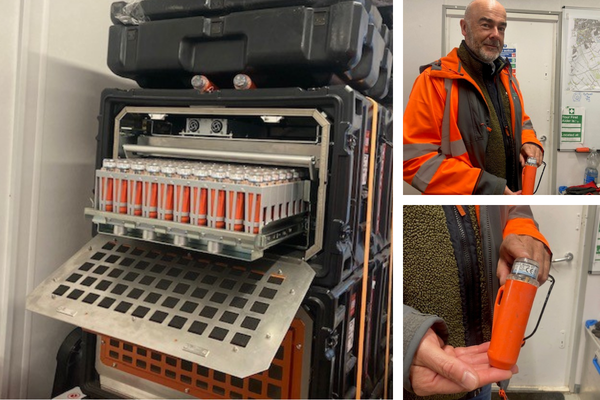
At work: Mark Rees, director Eco Geo with a node used as part of the seismic testing work.
The ‘nodes’: During our visit to York we saw some of the early work in action including seismic survey testing. The survey created opportunities for student involvement and more than 100 local residents also volunteered to host survey garden nodes - known as ‘gnodes’.
Photo credits: Salix Finance
Salix chief executive Kevin Holland and our director of decarbonisation Ian Rodger are both featured in the report, highlighting the importance of the project and Salix’s ongoing role in supporting its delivery.
Kevin Holland said: “Our Salix teams have been onsite in York several times to see firsthand the determination and expertise powering the project. We’re excited to support the next phase as drilling begins, and how this pioneering initiative will help lead the way towards a cleaner, more secure energy future for the UK.”
The report reflects on significant progress made during the project’s first year. This includes planning approval, extensive geological surveys, contractor appointments and continued engagement with local communities, researchers and government.
Once operational, the geothermal system will supply heat to the majority of the university’s campus buildings through its existing district heating network.
The idea is that future phases will explore electricity generation and the expansion of heat capacity, with the long-term ambition of supporting a wider geothermal heat network across the City of York.
Ian Rodger said: “This geothermal project will be an example of sustainable energy innovation as well as showing us how education, research and community can come together to tackle climate change.”
The project forms a central part of the University of York’s Sustainability Plan 2030 and is expected to begin generating heat in 2028.
Alongside delivering significant carbon savings, it is creating new opportunities for research, education and skills development, helping position Yorkshire as a centre of excellence for geothermal energy.
Professor Charlie Jeffery, Vice-Chancellor and President of the University of York, said the initiative would become a “living laboratory” for research while supporting the UK’s transition to homegrown clean energy.
The report also features support from York Central MP Rachael Maskell, who described the scheme as an important project for both sustainability and education.
She said: “This project not only reduces carbon emissions but also serves as a hub for research and education, fostering the next generation of renewable energy experts.
“Its community-focused approach will also contribute to York’s broader sustainability goals, creating a greener, more prosperous future for the city.”
Working closely alongside the University of York, at Salix we continue to support the project as it moves into its next major phase, helping deliver one of the UK’s most significant public sector decarbonisation projects and demonstrating how innovative renewable technologies can help transform the country’s energy future.
Our Salix teams have been onsite in York several times to see firsthand the determination and expertise powering the project. We’re excited to support the next phase as drilling begins, and how this pioneering initiative will help lead the way towards a cleaner, more secure energy future for the UK.

The trucks used as part of the seismic testing work at the University of York.
Photo credits: Salix Finance
What is geothermal?
Geothermal energy uses the Earth’s natural heat to provide reliable, renewable heating, cooling and electricity.
It works by drilling into the Earth’s crust to access naturally heated water, which is brought to the surface and its heat transferred into energy systems before the cooled water is returned underground to be reheated and reused.
Around 90 countries already use geothermal energy in this way.
At the University of York, a planned geothermal system will supply hot water to the campus district heating network, helping to reduce reliance on fossil fuels. Geothermal energy offers a constant 24/7 supply, unlike wind or solar, and can improve energy security by reducing dependence on imported fuels.
Although installation costs are high, operating costs are low, providing stable long-term energy prices. It also has a small land footprint, supports green jobs, and plays an important role in tackling climate change through low-carbon, sustainable energy.
Factfile
- £35 million awarded through the Public Sector Decarbonisation Scheme to support phase one.
- First UK university campus to host a deep geothermal energy project of this scale.
- Heat generation expected in 2028, supplying most campus buildings through the existing district heating network.
- Future phases will explore electricity generation and expanded heat capacity for the wider city.
- The project is creating a living laboratory for research, innovation and skills development in geothermal energy.
- Community engagement has included public open days, lectures, research workshops and stakeholder events.
- The project supports the UK’s transition to cleaner, more secure homegrown energy while helping reduce carbon emissions.