
Public sector leaders encouraged to seize climate neutral opportunities at Cardiff event
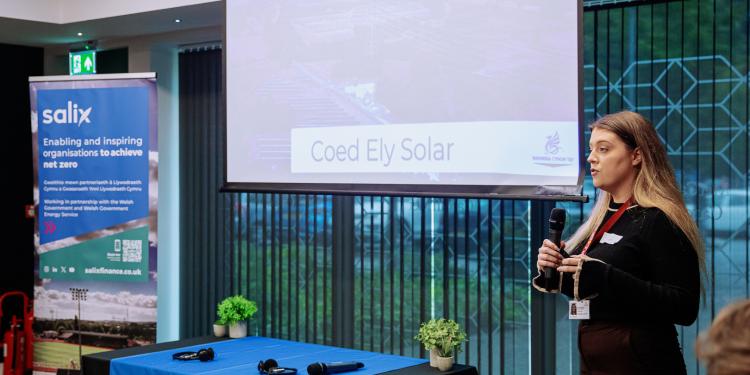
Speakers highlighted the support, expertise and funding available to help organisations turn net zero ambitions into practical projects across Wales
“Today is a call to action. Let’s use the support available, work together and reinvigorate our collective journey to Net Zero”.
That was the message from Welsh Government’s head of public sector climate, Zeba Tahsin, as public sector professionals from across Wales gathered at Cardiff Metropolitan University for the latest Net zero in practice: Wales’ public sector event.
Bringing together representatives from local authorities, health boards, universities and public sector organisations, the event focused on one central theme: how organisations can make the most of the expertise, funding and support already available to help deliver meaningful progress towards net zero.
Throughout the day, attendees heard practical examples from organisations already delivering projects on the ground, alongside advice from Salix and the Welsh Government Energy Service on how to move ideas from concept to reality.
Opening the function, director of public sector decarbonisation at Salix, Ian Rodger, welcomed attendees and encouraged organisations to make the most of the support available.
Today is about showcasing the full range of support and funding available to you - from the Energy Service and Salix, and making sure you have what you need to explore and deliver new opportunities Our goal is to help all of you move forward with confidence across the full range of net zero activity so we want to hear from you.
Supporting organisations every step of the way
Attendees first heard from our Salix team about the support available to organisations across Wales.
Our presentations highlighted how we work alongside public sector bodies to develop projects, secure investment and deliver practical carbon reduction measures.
Our team also shared examples of the technical support available, from building assessments and technology advice to project development and performance monitoring.
The message was clear. Successful projects are built on strong evidence, careful planning and access to the right expertise.
Delivering support across Wales
The Welsh Government Energy Service also provided an overview of its work supporting organisations across Wales.
Programme lead, Sam Wright-Green, reflected on both the challenge and opportunity ahead.
He said: “We know climate change is happening, but what's great about today is that everyone is in a unique position to help tackle that and move this agenda forward.
“These are not just projects we’re doing for carbon. They also bring other benefits through investment in public infrastructure and reducing energy costs. We want everyone to benefit from that.”
Sam highlighted the growing impact of projects being delivered across Wales, including increasing levels of renewable energy generation, low carbon heat and electric vehicle infrastructure.
Director at the Welsh Government Energy Service, Jane Forshaw, encouraged attendees to think about how greater impact could be achieved through partnership working and strategic investment.
We are keen to do everything we can to support organisations. Understanding where emissions sit, understanding the costs and understanding how we can help deliver programmes is a huge part of that.
Building confidence through delivery
One of the strongest themes of the day was the importance of learning from organisations already delivering projects.
Assistant head of assets, governance and technical services at Cwm Taf Morgannwg University Health Board, Christopher Lewis, shared the health board’s experience of delivering an ambitious £11.5 million decarbonisation programme through the Wales Funding Programme, Invest to Save and the NHS Targeted Estates Fund.
The programme includes solar photovoltaic installations, LED lighting upgrades, building management system improvements, heat pump technology and battery storage.
The health board’s estate spans more than 60 sites and consumes approximately the same amount of energy as 7,500 homes.
Christopher explained that support and collaboration had been critical to navigating the complexity of delivery.
He said: “We need traction, expertise, support and funding. We see Re:fit as a vehicle for achieving our goals.
“The client needs to be fully engaged throughout the process. It needs everyone to back it. Support is out there and we urge people to use it.”
Reflecting on the support received, he added: “We had project management and support from the Welsh Government Energy Service which was worth its weight in gold in getting us through the process.”
Among the projects highlighted was a demonstrator site at Williamstown Medical Records, where an air source heat pump and battery energy storage system have been installed alongside existing solar generation.
The project has delivered a 62 per cent reduction in site carbon emissions while helping build confidence for future low carbon heat projects across the wider estate.
Using evidence to unlock investment
Project manager specialising in carbon reduction at Swansea Council, Simon Aspland, discussed the challenges and opportunities involved in decarbonising a complex estate of more than 860 buildings.
Since 2019/20, Swansea Council has achieved a 17.8 per cent reduction in energy emissions and a 16.5 per cent reduction in fossil fuel emissions.
Projects delivered include solar installations, electric vehicle charging infrastructure, fleet transition and one of Wales’ most extensive LED street lighting programmes.
Simon stressed the importance of evidence when building support for investment.
He added: “Evidence for me is critical. The data that we have is key for the business cases.”
He also reflected on the value of funding support.
He said: “Salix funding is a primary enabler because it removes the capital barrier. The first interactions I had with Salix were around LED street lighting and they were amazing. They made it so easy for me.”
Simon also spoke about the importance of engaging schools and building awareness around energy use.
He said: “It’s a marathon, not a sprint.”
Understanding where energy is being used
As host venue, Cardiff Metropolitan University shared its own decarbonisation journey.
Chief officer of university environments, Graham Lewis, challenged attendees to think differently about how buildings use energy.
Drawing on the university’s “Halve the Half” initiative, Graham highlighted data showing that more than half of electricity and gas consumption was taking place outside normal operating hours.
He said: “We were spending money on energy we didn’t need to use.
“You need to start with where the energy is used.”
Through a combination of operational improvements, renewable energy generation and estate-wide investment, Cardiff Metropolitan University is reducing emissions while improving resilience and managing long term energy costs.
Graham encouraged attendees to think about decarbonisation as part of a wider organisational picture.
He said: “Don’t treat these things in isolation. They need to be paired together.
“When there’s a cost reduction, there’s an energy saving, infrastructure benefits and business continuity. It’s holistic.”
He added: “You have the power to make a difference.”
Turning strategy into action
The final case study came from Rhondda Cynon Taf County Borough Council.
Principal carbon reduction officer, Ffion Edwards, and carbon reduction officer, Katie Trembath, outlined how the council is embedding decarbonisation into long term decision making through strategic planning, carbon reporting and investment.
The council has set a target of becoming carbon neutral by 2030 and is increasing renewable energy generation across its estate.
A major focus of the presentation was the award-winning Coed Ely Solar Farm – project. Built on a reclaimed colliery site in Aberdare, the solar farm includes more than 9,400 solar panels and a private wire connection to Royal Glamorgan Hospital. The Hospital, which is located in Talbot Green, Rhondda Cynon Taf is managed by one of the days representatives, the Cwm Taf Morgannwg University Health Board.
The project is expected to generate around 6MWh of electricity annually and save approximately 7,355 tonnes of carbon emissions over its lifetime.
Reflecting on the project’s success, Katie highlighted the importance of partnership working.
She said: “We didn't have all of the experience in-house, so we brought in the right expertise and had the right team around us to help make the plan a reality.”
Learning from one another
The day concluded with a breakout session exploring the barriers organisations continue to face when developing decarbonisation projects.
Discussions focused on funding, procurement, governance, technical capacity and resource challenges, while also highlighting the value of peer learning and knowledge sharing.
Closing the event, Ian Rodger reflected on the progress being made across Wales.
He highlighted that more than £308 million has been invested through climate and energy programmes supporting the public sector since 2018.
He also emphasised the importance of understanding data, building confidence and seeking support when needed.
Ian said: “We heard some amazing examples of what projects are possible, how they work and what can be achieved.
“We heard about the importance of data and reporting, and how understanding your estate underpins everything.
Be ambitious. Think big. Welsh Government, the Welsh Government Energy Service and Salix are here to help. If you’re in any doubt, please ask.”
He closed with a quote from broadcaster and natural historian David Attenborough:
“The next chapter is ours to write. We know what we need to do and what’s next is up to us.”
The event demonstrated that while challenges remain, public sector organisations across Wales are already delivering practical projects, sharing expertise and building the foundations needed to achieve long term net zero ambitions.
This event was held on 17 June at Cardiff Metropolitan University’s Llandaff Campus and we would like to thank our hosts, speakers and guests for their interest and participation. Keep an eye on our website events area for further events and the news area for knowledge sharing.


